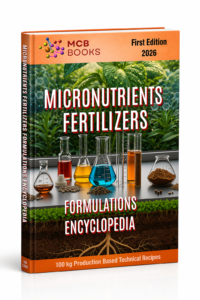
Micronutrients Fertilizers Encyclopedia: Recipes, Production and Applications
 Micronutrient fertilizers are essential for modern agriculture, providing plants with the trace elements required for healthy growth, improved yield,
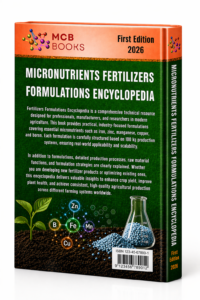 and resistance to environmental stress. Although needed in small amounts, micronutrients such as iron (Fe), zinc (Zn), manganese (Mn), copper (Cu), boron (B), and molybdenum (Mo) play critical roles in plant metabolism, enzyme activation, and chlorophyll production. The Micronutrients Fertilizers Encyclopedia: Recipes, Production and Applications offers a comprehensive resource for professionals seeking to understand and produce high-quality micronutrient fertilizers using proven industrial methods.
This encyclopedia focuses on practical and ready-to-use fertilizer recipes that can be directly applied in manufacturing environments. Each formulation is designed with carefully selected raw materials, balanced composition, and optimized performance. These recipes include liquid fertilizers, water-soluble powders, suspension concentrates, and granular products, allowing manufacturers to develop a wide range of products tailored to different agricultural needs. By providing detailed formulations, the encyclopedia helps reduce development time and ensures consistent product quality.
The production of micronutrient fertilizers requires precise control of several key parameters, including solubility, stability, and compatibility. In liquid formulations, micronutrients must remain fully dissolved and stable over time, which often requires the use of stabilizers and pH regulators. Water quality and mixing order also play a significant role in achieving a homogeneous and stable product. For powder and granular formulations, factors such as particle size distribution, moisture content, and blending uniformity are critical to ensure easy application and consistent nutrient delivery.
A major highlight of the encyclopedia is its emphasis on chelation technology. Chelated micronutrients, such as EDTA, DTPA, and EDDHA complexes, improve nutrient availability and uptake by plants, especially in soils with high pH levels. Chelation prevents micronutrients from becoming insoluble and unavailable, ensuring that plants can absorb them efficiently. The encyclopedia provides detailed guidance on how to incorporate chelating agents into formulations and optimize their performance in both liquid and solid products.
In addition to formulations and production methods, the encyclopedia also covers the practical applications of micronutrient fertilizers. Different crops and soil conditions require specific nutrient combinations and application techniques. The book explains how to select the right formulation for foliar spraying, fertigation, or soil application, ensuring maximum effectiveness. This application-focused approach makes the encyclopedia a valuable tool not only for manufacturers but also for agronomists and agricultural consultants.
The manufacturing process outlined in the encyclopedia includes essential steps such as raw material selection, precise weighing, controlled mixing, dissolution, quality control, and packaging. Each stage is designed to ensure consistent product performance and compliance with industry standards. Quality control measures, including pH testing, solubility analysis, and nutrient verification, are critical for maintaining product reliability.
With the increasing global demand for efficient and sustainable agricultural inputs, micronutrient fertilizers represent a growing and profitable market segment. Farmers are becoming more aware of the importance of balanced plant nutrition, driving the need for advanced micronutrient solutions. By using the recipes, production methods, and application strategies provided in this encyclopedia, manufacturers can develop competitive products and expand their presence in the fertilizer industry.
In conclusion, the Micronutrients Fertilizers Encyclopedia: Recipes, Production and Applications is a complete and practical guide for anyone involved in fertilizer production and use. It combines formulation expertise, industrial production knowledge, and real-world application insights, making it an indispensable resource for achieving success in modern agriculture.