Plant Growth Regulator Manufacturing for Flowering Crops
(Full Industrial Guide)
 In commercial agriculture, flowering performance often determines the final yield and market value of crops. When flowering is uneven or delayed, it directly affects fruit set, harvest timing, and overall quality. This is why plant growth regulators (PGRs) are widely used in flowering crops—they help manage the plant’s internal processes and create more consistent, predictable results.
Manufacturing these products at an industrial level requires more than basic mixing. It starts with selecting the right active ingredients. Most flowering-focused PGR formulations are built around hormones such as gibberellins, cytokinins, and sometimes auxins. Each plays a specific role. Gibberellins are typically used to stimulate flowering and support plant development. Cytokinins help improve flower quality and maintain plant vitality, while auxins contribute to overall balance and stability when used in controlled amounts.
However, active ingredients alone do not define product performance. Supporting components are just as important. Solvents are used to dissolve hormone-based actives that are not water-soluble. Surfactants improve spreading and absorption when the product is applied to plant surfaces. Stabilizers help protect sensitive compounds from degradation during storage and transport. In some formulations, chelating agents are included to improve compatibility with different water qualities and enhance overall effectiveness.
The manufacturing process follows a structured sequence to ensure consistency. It typically begins with dissolving the active ingredients in a suitable solvent system under controlled temperature conditions. This step is critical for achieving full solubility and preventing instability. Once the actives are properly dissolved, surfactants are added gradually with continuous mixing to maintain uniformity. Stabilizers and other additives are then introduced to strengthen the formulation.
After the main components are combined, pH adjustment is carried out. This is a key stage because plant hormones are sensitive to pH variations. Maintaining the correct range ensures both product stability and field performance. Once the formulation reaches the desired specifications, it is filtered to remove any undissolved particles and then filled into appropriate packaging.
Quality control is essential throughout the process. Consistency between batches, stability over time, and performance under different conditions all need to be verified. Even small formulation errors can lead to reduced effectiveness or product failure, which is why precision is so important in industrial production.
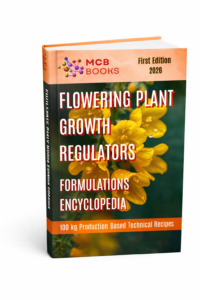
For manufacturers and entrepreneurs, developing a stable and effective PGR formulation from scratch can be challenging. Instead of relying on trial-and-error methods, many professionals prefer working with proven systems. The FLOWERING PLANT GROWTH REGULATORS FORMULATIONS ENCYCLOPEDIA offers ready-to-use formulations, optimized ingredient systems, and detailed production insights based on real industry experience.
In the end, successful manufacturing of plant growth regulators comes down to balance, control, and consistency. With the right formulation approach, it becomes possible to produce high-performance products that improve flowering and deliver reliable results in the field.