Flowering Plant Hormone Production Guide
(From Lab to Industrial Scale)
 In crop production, the flowering stage plays a major role in determining both yield and quality. Because of this, flowering plant hormones have become essential tools for growers who want more consistent and predictable results. But turning a concept into a reliable product requires more than basic knowledge—it involves a clear transition from lab-scale trials to full industrial production.
The process usually begins at the laboratory level, where the main goal is to develop a stable and effective formulation. At this stage, plant hormones such as gibberellins, cytokinins, and sometimes auxins are selected based on the target crop and desired effect. Small-scale tests are carried out to evaluate solubility, compatibility, and basic performance. This is also where the initial balance between active ingredients and supporting components is established.
Once the formulation shows promising results in the lab, the next step is optimization. This involves refining the solvent system, adjusting surfactant levels, and ensuring that the formulation remains stable under different conditions. Even small changes at this stage can significantly affect how the product performs later on. pH stability is also tested carefully, as plant hormones are sensitive to both acidic and alkaline environments.
After successful lab development, the formulation moves to pilot-scale production. This stage is crucial because it bridges the gap between theory and real-world manufacturing. Mixing behavior, temperature control, and processing time are evaluated more closely. The goal is to replicate lab results while working with larger volumes. Any inconsistencies detected at this stage are corrected before scaling up further.
Industrial-scale production requires a high level of control and consistency. Raw materials must be of reliable quality, and the mixing process needs to be standardized to ensure uniform results across batches. Active ingredients are typically dissolved in a suitable solvent system under controlled temperature conditions. Surfactants are added to improve application efficiency, while stabilizers help protect the formulation during storage and transport. In some cases, additional components are included to improve compatibility with different water conditions.
Quality control becomes even more important at this stage. Each batch must meet specific standards for stability, pH, and performance. Without proper quality checks, even a well-designed formulation can fail in the market. Packaging and storage conditions are also considered carefully to maintain product integrity over time.
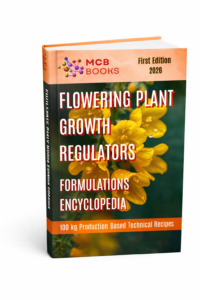
For many producers, scaling from lab to industrial production can be one of the most challenging steps. Trial-and-error approaches can lead to delays and increased costs. This is why many professionals prefer working with proven formulation systems. The FLOWERING PLANT GROWTH REGULATORS FORMULATIONS ENCYCLOPEDIA provides ready-to-use formulations and production insights that help simplify the transition and reduce development risks.
In the end, successful production of flowering plant hormones depends on careful planning, precise formulation, and consistent process control. When these elements are aligned, it becomes possible to produce high-quality products that perform reliably from the lab all the way to the field.