HOW TO MAKE FRUIT RIPENING REGULATORS:
INDUSTRIAL FORMULATION AND PRODUCTION GUIDE
Fruit ripening regulators play a critical role in modern agriculture, especially in post-harvest management and large-scale fruit distribution. These products are widely used to ensure uniform ripening, improve visual quality, and reduce losses during transportation and storage. Understanding how to make fruit ripening regulators at an industrial level is essential for manufacturers, agribusiness investors, and formulation chemists aiming to enter this growing market.
The most common mechanism behind fruit ripening regulators is the release or stimulation of ethylene, a natural plant hormone responsible for ripening. Industrial formulations typically rely on active ingredients such as ethephon, calcium carbide alternatives, or controlled ethylene-releasing compounds. Among these, ethephon-based systems are widely preferred due to their stability, efficiency, and ease of formulation. When applied, ethephon decomposes to release ethylene gas, triggering the ripening process in fruits like bananas, tomatoes, mangoes, and avocados.
A standard industrial formulation process begins with the careful selection of raw materials. This includes the active ingredient (such as ethephon), stabilizers to control decomposition, buffering agents to maintain pH, and surfactants to improve surface wetting and penetration. In liquid formulations, water is used as the primary carrier, and all components must be compatible to ensure long-term stability. The formulation must be designed to maintain a controlled release profile, preventing premature breakdown during storage.
Production typically involves controlled mixing under specific temperature and pH conditions. The active ingredient is gradually dissolved into the aqueous phase, followed by the addition of stabilizers and auxiliary agents. Continuous agitation ensures homogeneity, while pH adjustment is critical to prevent early ethylene release. Industrial manufacturers also implement filtration and quality control steps to guarantee consistency, purity, and performance of the final product.
From a commercial perspective, fruit ripening regulator production requires not only technical formulation knowledge but also compliance with agricultural regulations and safety standards. Packaging, labeling, and dosage instructions must be optimized for different fruit types and application methods, including spraying or controlled chamber exposure.
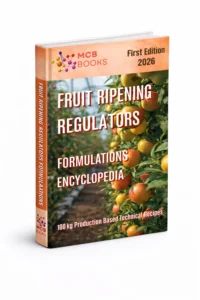
For professionals looking to scale production or develop high-performance formulations, access to detailed industrial recipes and proven systems is essential. The Fruit Ripening Regulators Formulations Encyclopedia provides ready-to-use, 100 kg production-based formulations, including raw materials, CAS numbers, and step-by-step manufacturing processes. This allows manufacturers to move quickly from concept to commercial product with confidence.