Chlormequat Chloride Plant Growth Inhibitor Production and Application Guide
Chlormequat chloride is one of the most important plant growth inhibitors used in modern agriculture for controlling excessive vegetative growth and improving crop stability. This highly effective growth regulator is widely applied in cereal production, greenhouse cultivation, ornamental plants, and various commercial crop systems. By promoting compact plant development and strengthening stem structure, chlormequat chloride helps farmers improve yield quality and reduce production losses caused by lodging and uncontrolled growth.
The primary function of chlormequat chloride is to regulate gibberellin biosynthesis inside the plant. Gibberellins are plant hormones responsible for stem elongation and rapid vegetative growth. When gibberellin activity is reduced, plants develop shorter internodes, stronger stems, improved root systems, and more balanced growth patterns. This allows crops to better tolerate environmental stress and maintain stable development under intensive farming conditions.
Chlormequat chloride is especially popular in wheat, barley, oats, and other cereal crops where lodging prevention is critical for maintaining harvest quality and maximizing yield efficiency. In greenhouse production systems, the product is commonly used to maintain compact vegetable and ornamental crops, improving light penetration, airflow, and overall crop appearance. Controlled plant growth also simplifies harvesting and reduces disease risks associated with dense vegetation.
The industrial production of chlormequat chloride formulations requires advanced formulation expertise and careful raw material balancing. Commercial formulations are commonly manufactured as soluble liquids or suspension concentrates depending on crop requirements and application methods. A professional formulation system may contain the active ingredient together with solvents, surfactants, stabilizers, dispersing agents, anti-foam agents, pH regulators, and preservation systems.
During the manufacturing process, the active ingredient is gradually incorporated into the carrier system under controlled mixing conditions to ensure complete homogenization and long-term formulation stability. Proper pH adjustment, viscosity control, and storage stability testing are essential to produce high-quality commercial products suitable for agricultural applications.
Application timing is extremely important for obtaining the best performance from chlormequat chloride formulations. In cereal crops, treatments are generally applied during early vegetative growth stages to improve stem strength and reduce lodging risks. In greenhouse and ornamental systems, lower application rates are often preferred to maintain compact and visually attractive plant structures.
As modern agriculture increasingly focuses on crop quality, space efficiency, and production stability, demand for professional chlormequat chloride formulations continues to grow globally. Manufacturers and agribusiness companies require advanced production systems capable of delivering reliable performance, crop safety, and long shelf life.
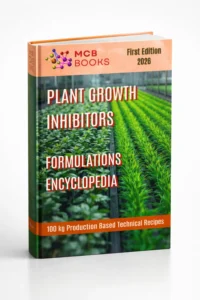
The Plant Growth Inhibitors Formulations Encyclopedia provides industrial-scale formulation technologies for chlormequat chloride and other plant growth inhibitors. The encyclopedia includes professional recipes, raw material details, CAS numbers, production methods, and advanced agrochemical manufacturing systems for commercial agricultural production.