Plant Growth Retardants vs Plant Growth Inhibitors: Differences and Industrial Uses
Plant growth retardants and plant growth inhibitors are essential technologies used in modern agriculture, greenhouse cultivation, and commercial crop production. Although these terms are often used interchangeably, there are important differences between plant growth retardants and plant growth inhibitors in terms of their mode of action, application areas, and industrial uses. Understanding these differences is extremely important for manufacturers, agribusiness companies, and professional growers seeking effective crop management solutions.
Plant growth retardants are specialized agrochemicals that primarily reduce stem elongation and excessive vegetative growth without completely stopping plant development. These products usually work by suppressing gibberellin biosynthesis, which controls cell elongation and shoot growth. Common plant growth retardants include chlormequat chloride, paclobutrazol, daminozide, and mepiquat chloride. These products help plants develop shorter internodes, stronger stems, better root systems, and improved resistance to lodging.
Plant growth inhibitors, on the other hand, represent a broader category of agricultural chemicals that suppress or regulate various physiological processes inside the plant. While many inhibitors also affect gibberellin activity, some may target cell division, flowering behavior, or other metabolic pathways depending on the intended agricultural purpose. Plant growth inhibitors are commonly used to control excessive crop growth, improve compact plant structure, regulate flowering, or manage greenhouse crop size.
In industrial agriculture, both plant growth retardants and plant growth inhibitors are widely used in cereals, vegetables, cotton, fruit orchards, ornamental plants, turf systems, and greenhouse production. These technologies improve crop uniformity, increase harvest efficiency, strengthen plant structure, and support higher commercial quality. Controlled plant growth also improves air circulation and light penetration while reducing disease pressure in dense crop systems.
The industrial manufacturing process for plant growth retardants and inhibitors requires advanced formulation expertise. Commercial products may be produced as soluble concentrates, suspension concentrates, wettable powders, or emulsifiable concentrates. Professional formulations generally include active ingredients together with solvents, surfactants, stabilizers, dispersing agents, wetting agents, and pH regulators to improve product stability and biological performance.
As global agriculture increasingly focuses on high-efficiency farming and controlled crop management, demand for advanced plant growth regulation technologies continues to rise. Manufacturers are searching for professional formulation systems capable of delivering long shelf life, reliable crop safety, and consistent field performance.
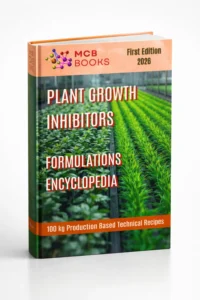
The Plant Growth Inhibitors Formulations Encyclopedia provides industrial-scale formulation technologies for plant growth retardants and inhibitors used in modern agriculture. The encyclopedia includes commercial production methods, raw material details, CAS numbers, manufacturing systems, and advanced agrochemical formulation techniques for professional agricultural production.