 Starting a granular NPK fertilizer production plant requires careful planning, reliable formulations, suitable equipment, and a well-designed manufacturing process. Granular NPK fertilizers supply nitrogen, phosphorus, and potassium in different ratios to meet the nutritional requirements of field crops, vegetables, fruit trees, greenhouse plants, and other agricultural products. For entrepreneurs and fertilizer manufacturers, developing a successful production facility begins with selecting the target fertilizer grades and understanding the technical requirements of commercial manufacturing.
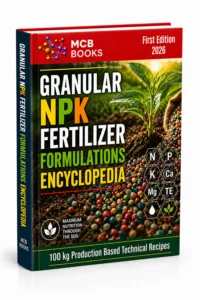
The first stage is formulation planning. Manufacturers may produce common grades such as NPK 15-15-15, NPK 20-10-10, NPK 12-12-17, NPK 10-20-20, and NPK 8-24-24. Custom blends can also be developed for specific crops, soils, and growth stages. Typical raw materials include urea, ammonium sulfate, monoammonium phosphate, diammonium phosphate, potassium chloride, potassium sulfate, mineral fillers, binders, coating agents, anticaking materials, and micronutrient compounds. The GRANULAR NPK FERTILIZER FORMULATIONS ENCYCLOPEDIA provides practical information about raw material functions, production formulas, nutrient ratios, and manufacturing procedures.
A commercial granular fertilizer plant generally requires raw material storage systems, weighing units, crushers, screens, mixers, granulators, dryers, coolers, coating equipment, conveyors, dust collection systems, packaging machines, and laboratory equipment. The selected equipment capacity should match the planned daily or annual production volume. Manufacturers should also consider energy consumption, available factory space, automation level, maintenance requirements, worker safety, and future expansion plans.
Process design begins with the organized movement of raw materials from storage to weighing and mixing. Accurate dosing is essential because incorrect quantities may change the declared nutrient composition of the finished fertilizer. After mixing, the material is transferred to a drum granulator, pan granulator, or another suitable granulation system. Water, steam, or a binder may be introduced to help particles combine and form stable granules.
The wet granules are then dried to reduce moisture and improve mechanical strength. Cooling prevents condensation, caking, and packaging problems. Screening separates acceptable granules from oversized and undersized particles. Oversized material may be crushed, while fines can be returned to the granulation stage. A coating or anticaking agent may then be applied to improve flowability, reduce dust, and increase storage stability.
Quality control should be integrated into every stage of production. Finished fertilizer must be tested for nitrogen, phosphorus, potassium, moisture, particle size, bulk density, granule hardness, dust level, and caking tendency. Packaging weight, label information, batch records, and storage conditions should also be monitored.
The GRANULAR NPK FERTILIZER FORMULATIONS ENCYCLOPEDIA can support entrepreneurs, agricultural engineers, production managers, investors, and fertilizer companies planning to establish or expand a manufacturing facility. Reliable formulas and properly selected equipment can reduce production errors, improve product consistency, and support the development of marketable fertilizer grades.
With technical formulations, manufacturing guidance, and production-focused information, the GRANULAR NPK FERTILIZER FORMULATIONS ENCYCLOPEDIA is a valuable resource for businesses seeking to build a professional granular NPK fertilizer production plant.