Producing soil conditioner fertilizers on a professional scale requires more than combining several agricultural raw materials in a mixing tank. A successful commercial product must be based on a balanced formulation, suitable raw material compatibility, correct production sequence and reliable quality-control procedures. For this reason, 100 kg soil conditioner fertilizer formulas are highly useful for manufacturers because they provide a practical production basis that can be tested, optimized and scaled according to industrial requirements.
Soil conditioner fertilizers may be designed for different agricultural purposes. Some products focus on improving soil structure and aggregation, while others are developed to support organic matter levels, water-holding capacity, nutrient availability, root-zone conditions or the management of saline and alkaline soils. The formulation of each product should therefore be selected according to its intended field application and the characteristics of the target soil.
A typical soil conditioner fertilizer formulation may contain humic acid, fulvic acid, organic matter sources, calcium compounds, gypsum, magnesium sources, biochar, amino acids, seaweed extracts, micronutrients and various functional additives. Liquid formulations may also require dispersing agents, stabilizers, pH regulators, preservatives or suspending materials depending on the composition of the product.
Using a 100 kg production formula makes manufacturing calculations easier and more practical. Each raw material can be expressed directly in kilograms, allowing producers to clearly understand the percentage contribution of every ingredient. For example, a component used at 5 kg in a 100 kg batch represents approximately 5% of the total formulation. This approach also simplifies the conversion of pilot formulations into larger commercial batches.
However, increasing production capacity should not mean simply mixing ingredients without process control. Raw material addition order, mixing speed, temperature, pH, particle size and dissolution time can all influence final product stability. In suspension-type soil conditioners, particle distribution and sedimentation must be controlled carefully. In granular products, manufacturers must also consider granulation, drying, screening and final particle-size distribution.
Industrial production additionally requires strict quality checks. Depending on the product, parameters such as pH, density, viscosity, moisture content, organic matter, humic substance concentration, nutrient content, appearance and storage stability may need to be monitored. These controls help ensure that every production batch remains consistent.
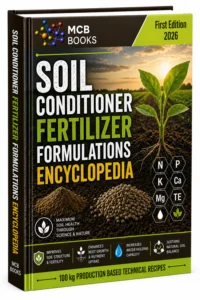
The SOIL CONDITIONER FERTILIZER FORMULATIONS ENCYCLOPEDIA provides practical soil conditioner formulations structured around 100 kg production quantities, together with raw material functions, manufacturing procedures, technical specifications and application information. These examples can provide a useful starting point for laboratory trials and professional product-development work.
For fertilizer manufacturers and agricultural input companies, standardized 100 kg soil conditioner fertilizer formulas offer a practical route from formulation development to industrial manufacturing. With the correct technical knowledge, producers can develop liquid, powder, suspension and granular soil conditioner products for different agricultural markets and soil-management applications.