 Modern soil conditioner fertilizer formulations are designed to improve soil properties while supporting healthier root-zone conditions and more efficient agricultural production. Among the most widely used raw materials in these products are humic acid, fulvic acid, gypsum and biochar. Each material performs a different function, and when selected and formulated correctly, they can be used to develop professional soil conditioner products for a wide range of soil types and agricultural applications.
Humic acid is commonly used in soil conditioner formulations because of its ability to interact with soil particles and organic matter. It can support soil aggregation, improve cation exchange capacity and help create more favorable conditions for nutrient retention. Humic acid is especially valuable in soils with low organic matter content and can be incorporated into liquid, suspension, powder and granular soil conditioner products.
Fulvic acid is another important component of advanced soil conditioner fertilizer formulations. Its relatively high solubility makes it suitable for liquid products and fertigation systems. Fulvic acid can support nutrient mobility in the soil and may improve the availability of certain mineral elements in the root zone. It is frequently combined with humic acid to develop formulations that provide complementary soil-conditioning functions.
Gypsum is widely used in soil amendment and soil conditioner products containing calcium and sulfur. It is particularly important in formulations developed for sodic or structurally degraded soils. Calcium from gypsum can help support soil aggregation and improve physical soil conditions where excessive sodium causes poor structure. Gypsum-based soil conditioner formulations may therefore be used as part of professional soil-management programs for saline and sodic agricultural areas.
Biochar has become an increasingly important raw material in soil-conditioning products. Its porous structure can contribute to water retention, aeration and nutrient-holding capacity while also increasing stable carbon content in the soil. Depending on its source, production conditions and particle size, biochar may be incorporated into powder, granular or blended organic-mineral soil conditioners.
Combining these materials requires careful formulation work. Humic acid and fulvic acid concentrations, gypsum particle size, biochar quality, pH, moisture content and compatibility with other ingredients must all be considered. Manufacturers may also combine these components with organic matter, amino acids, seaweed extracts, calcium, magnesium and micronutrients to develop more specialized products.
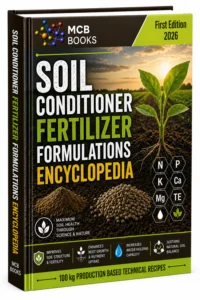
The SOIL CONDITIONER FERTILIZER FORMULATIONS ENCYCLOPEDIA provides practical formulation examples based on 100 kg production quantities, together with raw material functions, manufacturing procedures, technical specifications and application information. This structure helps fertilizer manufacturers and agricultural input companies understand how different soil-conditioning materials can be incorporated into professional products.
For companies looking to manufacture humic acid soil conditioners, fulvic acid fertilizers, gypsum-based soil amendments or biochar soil conditioners, organized formulation knowledge can significantly simplify product development. The encyclopedia offers a practical technical foundation for laboratory trials, pilot production and commercial-scale soil conditioner manufacturing.