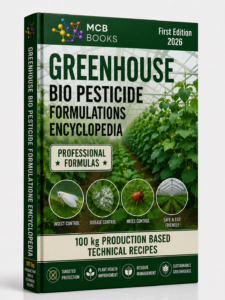
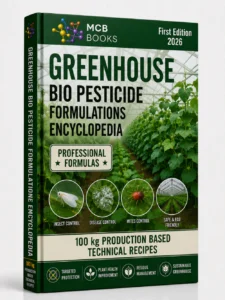
 Modern greenhouse agriculture requires effective and sustainable crop protection strategies because protected growing environments can create favorable conditions for insects, mites, fungal diseases, nematodes, and soil-borne pathogens. High humidity, dense planting, controlled temperatures, and continuous production cycles may allow pest and disease problems to spread rapidly. For manufacturers and agricultural professionals looking to develop biological crop protection products, the GREENHOUSE BIO PESTICIDE FORMULATIONS ENCYCLOPEDIA provides a practical technical resource focused on greenhouse biopesticide formulations, production methods, and professional agricultural applications.
Greenhouse crops such as tomato, pepper, cucumber, eggplant, strawberry, lettuce, leafy vegetables, and ornamental plants can be affected by many economically important pests. These may include whiteflies, aphids, thrips, spider mites, caterpillars, mealybugs, and other greenhouse insects. Biological pesticide formulations can be developed to help manage these pests while supporting integrated pest management programs and reducing dependence on conventional chemical crop protection products.
Fungal diseases are another major concern in protected agriculture. High relative humidity and limited air circulation may increase the development of diseases such as Botrytis, downy mildew, Alternaria, leaf spot diseases, seedling diseases, and root rot. Greenhouse biofungicide formulations can be designed for preventive or supportive biological disease management, depending on the crop, pathogen, application method, and formulation technology.
The GREENHOUSE BIO PESTICIDE FORMULATIONS ENCYCLOPEDIA also addresses biological solutions for root-zone and soil-related problems. Greenhouse production systems may experience root diseases, soil-borne pathogens, and root-knot nematodes that negatively affect plant development and crop productivity. Biological formulations intended for soil treatment, root-zone application, growing media, hydroponic systems, and drip irrigation can therefore represent an important category of professional greenhouse products.
Commercial greenhouse biopesticide manufacturing requires more than selecting a biological active component. The final formulation must provide suitable stability, compatibility, dispersibility, application performance, storage properties, and reliable product quality. Depending on the product type, manufacturers may use carriers, stabilizers, wetting agents, dispersing agents, suspending agents, protective materials, fillers, and other functional ingredients. Raw material selection and correct manufacturing procedures are essential because biological active materials may be sensitive to temperature, moisture, pH, oxygen, or incompatible formulation components.
The encyclopedia provides practical information about greenhouse bioinsecticides, biofungicides, bionematicides, soil and root-zone formulations, liquid biopesticides, drip irrigation products, and integrated biological crop protection solutions. It also supports manufacturers in understanding formulation principles, industrial production methods, application guidelines, technical properties, and product development considerations.
The GREENHOUSE BIO PESTICIDE FORMULATIONS ENCYCLOPEDIA is particularly suitable for biopesticide manufacturers, agricultural input companies, formulation specialists, R&D departments, greenhouse crop professionals, entrepreneurs, and investors seeking practical knowledge about biological pest and disease control. By combining formulation technology with professional greenhouse applications, the encyclopedia provides a strong technical foundation for developing stable, practical, and commercially applicable biological crop protection products.