 Cucumber production can be seriously affected by insect pests, mites, fungal diseases and soil-borne pathogens, especially in intensive greenhouse and open-field cultivation systems. Aphids, whiteflies, thrips, spider mites, caterpillars, powdery mildew, downy mildew, Fusarium wilt, Pythium root rot and Rhizoctonia are among the major problems that can reduce plant vigor, fruit quality and marketable yield. For this reason, the development and manufacture of bio pesticides specifically designed for cucumber production has become increasingly important in modern crop protection.
The first step in manufacturing cucumber bio pesticides is selecting suitable biological active ingredients according to the target pest or disease. These may include beneficial bacteria, fungi, microbial metabolites, botanical extracts, natural oils and other biologically derived materials. Each active ingredient has different requirements regarding pH, temperature, solubility, stability and compatibility, so formulation design must be adapted accordingly.
Raw materials used in bio pesticide formulations may also include carriers, emulsifiers, wetting agents, dispersing agents, suspension stabilizers, buffers, preservatives, antifoaming agents and other formulation auxiliaries. These ingredients help maintain product uniformity, improve spreading on cucumber leaves and support the physical stability of the finished formulation during storage and application.
Water quality is particularly important in liquid bio pesticide production. High hardness, excessive chlorine, unsuitable pH or microbial contamination may negatively affect biological ingredients. Purified or properly conditioned water is therefore commonly used, while pH should be adjusted to a range compatible with the selected active material.
Commercial manufacturing generally begins with preparation of the liquid phase, followed by controlled addition of formulation auxiliaries and active ingredients. Microbial materials should usually be incorporated under mild temperature and shear conditions to help maintain viable cells or spores. Botanical extracts and oil-based materials may require controlled emulsification or homogenization to obtain a stable and uniform product.
Different formulations can be developed according to the intended application. Foliar bio insecticides can be produced for aphids, whiteflies, thrips and mites, while bio fungicides may target powdery mildew, downy mildew and other foliar diseases. Root-zone and soil-applied formulations can be designed for biological management of Fusarium, Pythium, Rhizoctonia and related soil-borne pathogens.
Quality control is essential for commercial production. Parameters such as appearance, pH, density, viscosity, dispersion, sedimentation behavior, storage stability and microbial quality should be monitored. For microbial products, viable microorganism concentration is also an important indicator of product performance and shelf stability.
Packaging should protect the formulation from heat, light, moisture and oxygen where these factors can reduce biological activity. Correct labeling, storage conditions and batch traceability are also important elements of professional manufacturing.
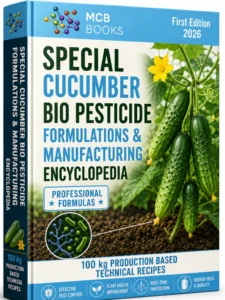
The Special Cucumber Bio Pesticide Formulations & Manufacturing Encyclopedia provides practical guidance on formulation design, raw material selection, manufacturing procedures and quality-control principles. It is intended for agricultural manufacturers, formulation specialists, researchers and entrepreneurs seeking to develop professional bio pesticide products for sustainable and effective cucumber crop protection.