Melon and watermelon crops can be affected by numerous pests and diseases during vegetative growth, flowering, fruit set and fruit development. Aphids, whiteflies, thrips, spider mites, caterpillars, powdery mildew, downy mildew, Fusarium wilt, root rot and other soil-borne pathogens may cause serious economic losses if they are not controlled effectively. For manufacturers developing biological crop protection products, standardized 100 kg bio pesticide formulas provide a practical foundation for commercial-scale production.
Bio pesticide formulations for melon and watermelon can be designed according to the specific target organism and intended application method. Products for aphids and whiteflies may contain botanical extracts, microbial metabolites, natural oils or selected biological active ingredients that interfere with pest feeding, reproduction or population development. Formulations targeting thrips and mites require good spreading and wetting characteristics because these pests often remain on protected areas of leaves and flowers.
A properly designed 100 kg formulation generally contains an active biological component together with suitable carriers and formulation auxiliaries. Depending on the product type, these may include wetting agents, emulsifiers, dispersing agents, suspension stabilizers, buffers, preservatives, antifoaming agents and other materials required to maintain physical and biological stability. The exact composition must be selected according to the properties of the active ingredient and the desired final formulation.
Fungal diseases are another major concern in melon and watermelon production. Biological formulations can be developed for powdery mildew, downy mildew, Botrytis and other foliar diseases. Beneficial microorganisms and their metabolites may help suppress pathogens through competition, antibiosis or other biological mechanisms. Botanical extracts and naturally derived active substances can also be incorporated into suitable formulations where permitted.
Soil-borne diseases such as Fusarium wilt, Pythium root rot and Rhizoctonia-related problems require a different formulation approach. Products intended for drip irrigation, root-zone treatment or soil application must remain stable in water and be compatible with irrigation systems. Microbial bio pesticides may also help establish beneficial populations around plant roots and reduce the opportunity for harmful microorganisms to dominate the rhizosphere.
Commercial production of 100 kg batches requires careful process control. Water quality, mixing sequence, temperature, pH, homogenization and storage conditions can significantly affect the final product. Microbial materials should be processed under conditions that preserve viable cell or spore counts, while botanical and oil-based products require appropriate emulsification and stabilization.
Quality control should include parameters such as appearance, pH, density, viscosity, dispersion, sedimentation, storage stability and microbiological quality where applicable. Reliable batch-to-batch consistency is particularly important when products are manufactured for professional agricultural use.
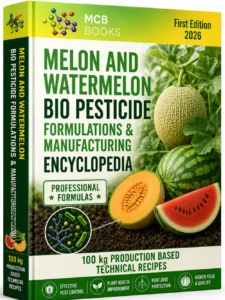
The Melon and Watermelon Bio Pesticide Formulations & Manufacturing Encyclopedia provides practical 100 kg production concepts for developing bio insecticides, bio acaricides, bio fungicides and soil-applied biological products. By combining raw material selection, formulation technology, manufacturing procedures and quality-control principles, manufacturers can develop specialized biological solutions for the major pest and disease challenges encountered in commercial melon and watermelon production.