The Bio Insecticide Formulations Encyclopedia is designed to provide practical technical knowledge for the development and commercial production of biological insect control products used against important agricultural pests. Professional bio insecticide formulations can be developed for pests such as aphids, thrips, whiteflies, caterpillars, leaf miners, beetles, mites, and other insects that cause economic losses in greenhouse and open-field crops.
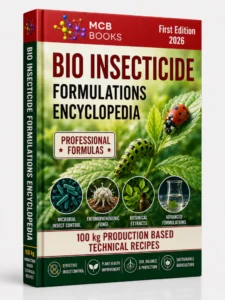
A 100 kg production scale is commonly used as a practical reference for industrial formulation planning because it allows manufacturers to understand the proportional relationship between active ingredients, carriers, stabilizers, surfactants, dispersing agents, and other functional components. The exact composition of a bio insecticide depends on the biological active material, target pest, intended application method, crop type, and required product form.
Bio insecticides used against aphids and whiteflies may be based on microbial agents, botanical extracts, naturally derived compounds, or biological metabolites. These products are generally formulated to improve contact with plant and insect surfaces while maintaining the activity of the biological component. Wetting agents and adhesion-supporting materials can help provide better coverage during foliar application.
Thrips control requires formulations capable of reaching insects hidden within flowers, young leaves, and protected plant tissues. Appropriate spreading and wetting characteristics therefore play an important role in formulation performance. Stability and compatibility must also be carefully managed to protect sensitive biological ingredients during storage and application.
For caterpillar control, biological insecticides may utilize microorganisms or biologically derived active substances that act specifically on susceptible larval stages. Product effectiveness depends not only on the active component but also on particle size, suspension quality, dispersion, formulation stability, and correct field application timing.
Commercial 100 kg bio insecticide formulations may include carriers, emulsifiers, dispersants, stabilizers, suspending agents, preservatives, anti-foaming agents, UV-protective components, and other formulation aids. Every ingredient must be selected according to its compatibility with the biological active material. Excessive heat, extreme pH values, unsuitable preservatives, or aggressive processing conditions can reduce biological activity and shorten product shelf life.
Quality control is therefore a critical part of professional production. Finished bio insecticides should be evaluated for parameters such as appearance, pH, viscosity, density, dispersibility, suspension stability, microbial viability where applicable, contamination, storage stability, and biological performance.
The Bio Insecticide Formulations Encyclopedia offers manufacturers and agricultural professionals a structured resource for understanding 100 kg production concepts, formulation design, raw material functions, manufacturing procedures, and application-oriented product development. With proper formulation and quality control, biological insecticides can become valuable components of modern integrated pest management programs for controlling a wide range of agricultural pests.