 Starting an alginic acid powder manufacturing plant requires careful planning because the process involves raw material preparation, chemical extraction, separation, precipitation, purification, drying, milling, quality control, and waste management. A successful plant must be designed around consistent production quality, process efficiency, equipment compatibility, and operating cost control.
The main raw material is brown seaweed, selected according to its alginate content, moisture level, cleanliness, seasonal availability, and consistency. Depending on the selected process route, additional process chemicals may be required for alkaline extraction, acidification, washing, neutralization, and water treatment. Reliable raw material sourcing is essential because variations in seaweed quality can directly affect extraction yield and final product performance.
The production line typically begins with seaweed washing, cleaning, size reduction, and preparation equipment. The prepared material is then transferred to extraction vessels equipped with agitation, temperature control, and suitable chemical-resistant construction. During alkaline extraction, alginate compounds are converted into a soluble form.
The extracted material must then pass through solid-liquid separation and clarification systems. Depending on plant design and production capacity, equipment may include filters, screens, centrifuges, pumps, tanks, presses, and purification units. The clarified solution is subsequently processed through controlled precipitation to recover alginic acid.
After precipitation, the wet product is washed and dewatered before entering the drying stage. Dryers must provide controlled moisture removal without unnecessarily degrading product quality. The dried material is then transferred to milling and classification equipment to achieve the required alginic acid powder particle size.
Quality-control facilities are another important part of the plant. Routine testing may include moisture, pH, purity, particle size, appearance, ash content, and other specifications depending on the intended market.
The cost of an alginic acid manufacturing plant depends on several factors, including production capacity, seaweed price, chemical consumption, energy demand, water usage, labor, drying technology, equipment materials, wastewater treatment, automation level, packaging, and local infrastructure. Therefore, plant investment should be evaluated together with expected yield, operating efficiency, product grade, and target market.
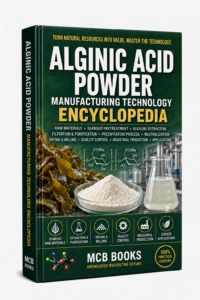
For manufacturers, investors, engineers, and entrepreneurs planning industrial production, the ALGINIC ACID POWDER MANUFACTURING TECHNOLOGY ENCYCLOPEDIA provides detailed information on raw materials, process flow, equipment selection, extraction technology, operating parameters, quality control, troubleshooting, and industrial-scale alginic acid powder production.