 Alginic acid and sodium alginate are closely related seaweed-derived materials, but they are not the same product. Both originate primarily from brown seaweed, and understanding the differences between them is important for manufacturers, formulators, engineers, and companies working with alginate-based raw materials.
The main difference begins with their chemical form. Alginic acid is the acidic form of alginate, while sodium alginate is the sodium salt of alginic acid. This difference significantly affects their solubility, processing behavior, and industrial applications.
In industrial production, brown seaweed is first cleaned, washed, and prepared for extraction. The alginate naturally present in the seaweed is generally converted into a soluble form through controlled alkaline extraction. After filtration and clarification, a sodium alginate-containing solution can be obtained.
To manufacture alginic acid powder, the extracted alginate is subsequently converted into its acidic form through a controlled precipitation process. The resulting alginic acid is separated, washed, purified, dewatered, dried, milled, and classified to obtain a stable powder with the required particle size and quality characteristics.
For sodium alginate manufacturing, the process follows a different conversion route. Alginic acid or another suitable alginate intermediate is neutralized with an appropriate sodium source to produce sodium alginate. The material is then processed through purification, drying, milling, and quality-control stages.
One of the most important practical differences is water solubility. Sodium alginate readily forms viscous aqueous solutions and is widely valued as a thickener, stabilizer, film-forming agent, and gel-forming material. Alginic acid itself has considerably lower water solubility and is often selected for applications where its acidic functional groups and specific chemical behavior are important.
Both products are used across industries including food processing, pharmaceuticals, cosmetics, biotechnology, textiles, agriculture, coatings, and specialty chemical formulations. However, the correct material must be selected according to the required solubility, viscosity, gel formation, pH behavior, purity, and end-use performance.
From a manufacturing perspective, successful production requires much more than simply extracting seaweed. Raw material selection, extraction conditions, filtration, precipitation, neutralization, washing, drying, milling, equipment selection, and quality control all influence the final product.
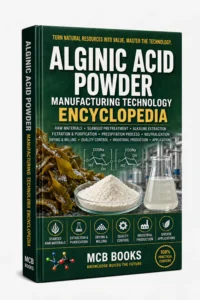
For professionals seeking a deeper understanding of alginic acid powder manufacturing, the ALGINIC ACID POWDER MANUFACTURING TECHNOLOGY ENCYCLOPEDIA provides detailed technical guidance covering brown seaweed preparation, extraction processes, production equipment, operating parameters, purification, drying, milling, quality control, troubleshooting, and industrial-scale production.