Best Plant Growth Inhibitors Used in Agriculture and Greenhouse Production
Plant growth inhibitors have become essential tools in modern agriculture and greenhouse production systems. These specialized agricultural chemicals help farmers control excessive vegetative growth, improve crop quality, strengthen plant structure, and increase overall production efficiency. As commercial agriculture continues to focus on higher yields and better crop management, demand for advanced plant growth inhibitor formulations is growing rapidly worldwide.
Plant growth inhibitors work by regulating plant hormone activity, particularly gibberellin biosynthesis, which directly affects stem elongation and vegetative growth. By limiting excessive growth, these products help plants develop stronger stems, more compact structures, improved flowering performance, and better nutrient utilization. Controlled plant development also improves air circulation and light penetration, reducing disease risks in dense crop systems.
Some of the most widely used plant growth inhibitors in agriculture include paclobutrazol, chlormequat chloride, mepiquat chloride, daminozide, and uniconazole. Paclobutrazol is commonly used in fruit trees, vegetables, ornamentals, and greenhouse crops to reduce excessive elongation and improve flowering performance. Chlormequat chloride is highly popular in cereal production for reducing lodging and increasing stem strength. Mepiquat chloride is extensively applied in cotton cultivation to optimize plant balance and improve harvest quality.
In greenhouse production systems, plant growth inhibitors are extremely important for maintaining compact crop structure and maximizing space efficiency. Controlled growth allows easier crop management, improved spray coverage, and more uniform fruit or flower development. Greenhouse vegetables, ornamental flowers, and nursery plants often rely on professional growth inhibitor technologies to achieve commercial-quality appearance and better transportation durability.
The industrial production of plant growth inhibitors requires advanced formulation techniques to ensure stability, crop safety, and long shelf life. Commercial formulations may include soluble liquids, suspension concentrates, emulsifiable concentrates, or wettable powders depending on crop requirements and application methods. Professional manufacturing systems also use surfactants, stabilizers, dispersing agents, and pH regulators to improve biological effectiveness and storage performance.
As the global agricultural sector becomes more technology-driven, professional plant growth inhibitor formulations continue to gain importance in both field agriculture and controlled greenhouse environments. Manufacturers and agribusiness companies increasingly search for reliable formulation systems that combine performance, stability, and commercial scalability.
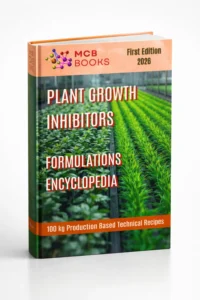
The Plant Growth Inhibitors Formulations Encyclopedia offers industrial-scale formulation systems for modern agriculture and greenhouse production. The encyclopedia includes professional recipes, raw material details, CAS numbers, manufacturing methods, and advanced agrochemical formulation technologies for commercial producers worldwide.