ETHYLENE-BASED FRUIT RIPENING FORMULAS: INDUSTRIAL PRODUCTION AND APPLICATION GUIDE
 Ethylene-based fruit ripening formulas are at the core of modern post-harvest technology, enabling producers to control ripening with precision, consistency, and scalability. Ethylene is a natural plant hormone that regulates the physiological processes responsible for fruit maturation, color development, and softening. In commercial agriculture, leveraging ethylene through well-designed formulations allows manufacturers and distributors to synchronize ripening, reduce waste, and deliver market-ready produce across global supply chains.
The most common approach in industrial formulations is the use of ethylene-releasing compounds such as ethephon. This active ingredient is widely adopted due to its stability in formulation and its ability to decompose into ethylene under specific conditions. When applied to fruits, ethephon penetrates plant tissues and gradually releases ethylene, triggering uniform ripening in crops such as bananas, mangoes, tomatoes, and avocados. This controlled release mechanism is critical for ensuring predictable performance and minimizing quality variations between batches.
In addition to ethephon-based systems, direct ethylene gas application is used in controlled ripening chambers. This method is particularly effective for large-scale operations where environmental conditions such as temperature, humidity, and gas concentration can be precisely regulated. However, liquid formulations remain more versatile and accessible for a wide range of agricultural applications, including spraying and dipping processes.
A successful ethylene-based fruit ripening formula requires more than just the active ingredient. Stabilizers are essential to prevent premature decomposition of ethephon during storage, while buffering agents help maintain the optimal pH range for product stability. Surfactants are incorporated to enhance wetting, spreading, and penetration on fruit surfaces, improving the overall efficiency of the formulation. Water is typically used as the primary carrier in liquid systems, and all components must be carefully selected to ensure compatibility and long shelf life.
The industrial production process involves precise raw material dosing, controlled mixing, and strict pH management. The active ingredient is introduced into the aqueous phase under continuous agitation, followed by the gradual addition of stabilizers and auxiliary components. Temperature control is maintained to preserve the integrity of the formulation, while filtration and quality control tests ensure consistency and compliance with commercial standards. These steps are essential for delivering a reliable product that performs effectively under real agricultural conditions.
In practical applications, ethylene-based fruit ripening formulas are used in post-harvest treatment facilities, warehouses, and distribution centers. Depending on the crop and logistics, the formulation can be applied through spraying, dipping, or controlled exposure systems. Proper dosage and timing are critical to achieving uniform ripening without compromising fruit quality or shelf life.
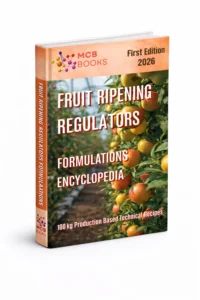
For manufacturers and formulation specialists aiming to develop competitive products, access to proven industrial systems is crucial. The Fruit Ripening Regulators Formulations Encyclopedia provides ready-to-use, 100 kg production-based formulations, complete with raw material details, CAS numbers, and step-by-step production processes. This comprehensive resource allows professionals to accelerate product development and scale their operations with confidence in the agricultural chemicals market.