
A professional heavy duty degreaser is designed for demanding cleaning jobs where ordinary cleaners are not strong enough. These products are commonly used to remove heavy grease, oil and stubborn industrial residues from machinery, equipment, metal surfaces and workshop areas.
The final performance depends on the right balance of cleaning agents, solvents, alkaline materials and supporting additives. For commercial production, using a reliable formulation helps manufacturers achieve consistent cleaning power, product stability and repeatable batch quality.
Different applications may require different heavy duty degreaser systems, which is why having more than one practical formulation can be valuable for professional manufacturing.
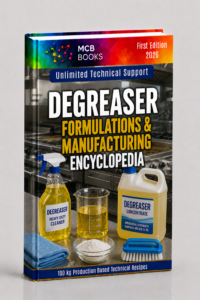
DEGREASER FORMULATIONS & MANUFACTURING ENCYCLOPEDIA
Looking for complete heavy duty degreaser formulations for professional production?
The
DEGREASER FORMULATIONS & MANUFACTURING ENCYCLOPEDIA
includes practical formulation options and industrial production processes for Heavy Duty Degreasers, together with solvent-based, water-based, engine, metal and other specialized degreaser systems.
It is designed for manufacturers who need more than a basic recipe and want practical formulation choices for developing commercial degreaser products.
Explore the complete DEGREASER FORMULATIONS & MANUFACTURING ENCYCLOPEDIA and discover professional formulation solutions for heavy duty degreaser production.
WHAT IS A HEAVY DUTY DEGREASER?
A heavy duty degreaser is a high-strength cleaning formulation designed to remove heavy oils, grease, and industrial dirt from surfaces.
These degreasers are typically more concentrated and aggressive than standard cleaners and are used in demanding cleaning environments.
FORMULATION OVERVIEW
Heavy duty degreasers contain a combination of strong surfactants, alkaline compounds, solvents, and additives.
Surfactants break down oils and grease. Alkaline builders enhance cleaning efficiency by saponifying fats and oils. Solvents help dissolve stubborn contaminants.
Additives such as corrosion inhibitors improve safety and protect surfaces.
KEY INGREDIENTS
The effectiveness of heavy duty degreasers depends on the selection of raw materials.
Anionic and nonionic surfactants provide cleaning action. Alkaline builders such as sodium hydroxide or sodium metasilicate improve grease removal.
Solvents enhance the dissolution of heavy oils. Corrosion inhibitors protect metal surfaces during cleaning.
PRODUCTION PROCESS
The production of heavy duty degreasers involves controlled mixing and formulation steps.
Water or solvent base is added first. Surfactants are introduced under agitation to ensure uniform dispersion.
Alkaline builders are added carefully to control pH levels. Solvents and additives are incorporated in the final stage.
The mixture is homogenized and tested for performance before packaging.
ADVANTAGES
Heavy duty degreasers provide superior cleaning power for industrial applications.
They effectively remove tough contaminants, reduce cleaning time, and improve operational efficiency.
LIMITATIONS
Due to their strength, heavy duty degreasers may be aggressive on sensitive surfaces.
Improper use can lead to corrosion or surface damage, especially on aluminum.
APPLICATION AREAS
Heavy duty degreasers are used in industrial cleaning, automotive maintenance, engine cleaning, and equipment degreasing.
They are ideal for removing heavy contamination in workshops and factories.
SUMMARY
Heavy duty degreaser formulations are essential for removing tough grease and industrial contaminants.
By combining strong surfactants, alkaline builders, and solvents, these formulations provide high-performance cleaning solutions.



Pingback: Concentrated Heavy Duty Alkaline Degreaser | Professional Formula
Pingback: Alkaline Metal Degreaser Formula | Professional Manufacturing
Pingback: Metal Degreaser Formula | Professional Manufacturing Guide