 Humic and fulvic fertilizer formulations are widely used in modern agriculture because they can be adapted to different application methods, including foliar spray, fertigation, and direct soil application. These products are commonly developed to support nutrient availability, root development, soil fertility, plant growth, and overall crop performance. For fertilizer manufacturers, humic and fulvic acid-based products offer flexible formulation opportunities for professional agriculture, greenhouse production, horticulture, field crops, and intensive cultivation systems.
Humic acid and fulvic acid are the primary components of these fertilizer formulations. Humic substances may be obtained from leonardite and other humic-rich materials, while potassium humate is frequently used as a soluble source in commercial products. Fulvic acid is especially useful in liquid formulations because of its high solubility. Depending on the intended application, these ingredients can be combined with amino acids, seaweed extracts, potassium compounds, nitrogen sources, micronutrients, organic acids, stabilizers, preservatives, and water.
Foliar humic and fulvic fertilizer formulations are designed for application directly to plant leaves. In these products, solubility, low sediment formation, suitable pH, and good spreading characteristics are particularly important. Fulvic acid is often preferred in foliar formulations because it can be incorporated into highly soluble nutrient systems. Compatible micronutrients such as iron, zinc, manganese, boron, and molybdenum may also be included to develop multifunctional foliar fertilizers.
Fertigation formulations are applied through irrigation systems and should remain sufficiently soluble and stable to reduce the risk of precipitation or blockage. Humic and fulvic fertilizers for fertigation may be combined with potassium, amino acids, seaweed extracts, or selected micronutrients. The formulation should be designed carefully according to water quality, irrigation system characteristics, crop requirements, and compatibility with other fertilizers used in the nutrition program.
Soil application represents another major use of humic and fulvic fertilizers. Humic acid, potassium humate, and leonardite-derived products can be incorporated into soil treatment programs designed to support soil conditioning, nutrient retention, root-zone development, and nutrient availability. Liquid or concentrated formulations can be applied directly to the soil or delivered near the plant root system.
Manufacturing these products requires careful control of mixing order, pH, temperature, solubility, density, viscosity, and filtration. Compatibility testing is especially important because some mineral nutrients may react with humic substances and cause sedimentation or precipitation. Finished products should also be evaluated for humic acid content, fulvic acid content, appearance, storage stability, and packaging compatibility.
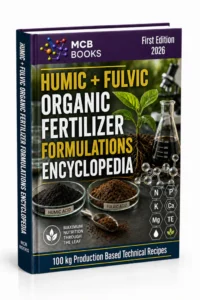
The HUMIC + FULVIC ORGANIC FERTILIZER FORMULATIONS ENCYCLOPEDIA provides practical technical information about foliar humic fertilizers, fertigation formulations, soil-applied humic products, raw materials, production methods, and quality control. It is designed for fertilizer manufacturers, formulators, agricultural companies, and entrepreneurs developing professional humic and fulvic fertilizer products for modern crop nutrition.