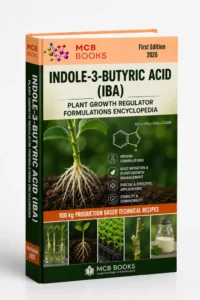
 Indole-3-Butyric Acid (IBA) is one of the most widely used auxin-type plant growth regulators in modern agriculture, horticulture, nursery production and plant propagation. It is especially valued for its ability to stimulate adventitious root formation, improve rooting performance in cuttings, support transplant establishment and contribute to stronger early plant development. Because the effectiveness of IBA depends greatly on concentration, formulation type, carrier system and application method, professionally developed formulations are essential for achieving consistent agricultural performance.
The INDOLE-3-BUTYRIC ACID (IBA) PLANT GROWTH REGULATOR FORMULATIONS ENCYCLOPEDIA provides technical information for understanding the formulation, production and practical use of IBA-based plant growth regulator products. It is designed as a reference for manufacturers, agricultural chemical producers, formulators, researchers, technical personnel and professionals interested in developing commercial IBA products for different crops and propagation systems.
IBA can be formulated in several commercial forms depending on the intended application. These may include soluble concentrates, liquid concentrates, emulsifiable systems, suspension-based products, rooting solutions, dipping preparations and other specialized formulations. Selecting the correct solvent system, surfactants, stabilizers, dispersing agents, wetting agents and supporting ingredients is important for obtaining good solubility, physical stability and uniform distribution of the active ingredient.
Commercial manufacturing of IBA plant growth regulators generally involves accurately weighing the raw materials, preparing the liquid or carrier phase, dissolving or dispersing the active ingredient, introducing functional additives and adjusting the final product to the required specification. Mixing conditions, temperature control, pH management and the order of ingredient addition can significantly influence product quality. After production, quality control procedures may include checks for active ingredient concentration, pH, appearance, density, stability, homogeneity and storage performance.
One of the major agricultural applications of IBA is the rooting of vegetative cuttings. It is commonly used in ornamental plants, fruit crops, forestry plants, nursery seedlings and numerous horticultural species where rapid and uniform root development is required. Depending on the crop and propagation technique, IBA products may be applied through quick dipping, prolonged soaking, basal treatment or other controlled application methods.
IBA formulations may also be used to improve transplant establishment by promoting stronger root systems and helping young plants adapt more effectively after planting. Healthy root development can improve water and nutrient uptake and contribute to vigorous early growth. However, application concentration and timing must always be adapted to the plant species, growth stage and production conditions.
For companies planning to manufacture professional plant growth regulator products, formulation knowledge is just as important as the active ingredient itself. Stability, compatibility, packaging, storage conditions and application performance must all be considered during product development.
The INDOLE-3-BUTYRIC ACID (IBA) PLANT GROWTH REGULATOR FORMULATIONS ENCYCLOPEDIA brings together formulation concepts, raw material information, manufacturing principles, application guidance and commercial production considerations in a practical technical resource. It can help professionals develop reliable IBA-based products for rooting, propagation, plant establishment and other specialized agricultural applications.