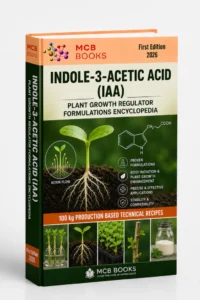
 Indole-3-Acetic Acid, commonly known as IAA, is one of the most important naturally occurring auxins involved in the regulation of plant growth and development. It plays a major role in cell elongation, root development, apical dominance, vascular differentiation, fruit development, and many other physiological processes. Because of its importance in plant biology, IAA is widely studied and used in agricultural, horticultural, propagation, and plant tissue culture applications. The INDOLE-3-ACETIC ACID (IAA) PLANT GROWTH REGULATOR FORMULATIONS ENCYCLOPEDIA provides detailed technical information about formulation technologies, raw materials, manufacturing methods, applications, and commercial production of IAA-based plant growth regulator products.
Commercial IAA formulations can be produced in different forms depending on the intended use, concentration, application method, and required storage stability. These may include liquid concentrates, soluble formulations, water-based products, powder formulations, rooting preparations, tissue culture products, and other specialized agricultural systems. Since IAA can be sensitive to environmental factors such as light, temperature, oxidation, and pH, formulation design and stabilization are particularly important.
A typical IAA plant growth regulator formulation may contain Indole-3-Acetic Acid as the active ingredient together with selected solvents, co-solvents, carriers, surfactants, wetting agents, stabilizers, antioxidants, buffers, preservatives, dispersing agents, and other formulation auxiliaries. Each component is selected to improve active ingredient stability, solubility, uniformity, storage performance, and ease of application.
The commercial manufacturing process generally begins with accurate weighing of the raw materials and preparation of the carrier or solvent phase. IAA is then dissolved or dispersed under controlled mixing conditions. Stabilizers, surfactants, buffers, and other functional ingredients are incorporated according to the formulation design. Depending on the product type, homogenization, filtration, controlled pH adjustment, or particle-size management may also be required.
IAA-based plant growth regulators are associated with a wide range of agricultural and horticultural applications. They may be used in programs designed to support root initiation, root development, cell elongation, shoot growth, fruit setting, vascular development, and overall plant growth. IAA is also important in plant tissue culture, where auxin concentration and the balance between auxins and cytokinins can significantly influence rooting, callus formation, and organ development.
Quality control is an essential part of commercial IAA production. Important parameters may include active ingredient concentration, appearance, pH, density, solubility, viscosity, stability, dilution behavior, packaging compatibility, and resistance to degradation during storage. Light-protective packaging and appropriate storage conditions may also be important for maintaining product quality.
The INDOLE-3-ACETIC ACID (IAA) PLANT GROWTH REGULATOR FORMULATIONS ENCYCLOPEDIA is designed as a practical technical reference for agrochemical manufacturers, formulation specialists, researchers, agricultural consultants, horticultural professionals, and companies developing auxin-based plant growth regulator products. By combining formulation principles, manufacturing methods, raw material functions, application concepts, and commercial production considerations, the encyclopedia provides a comprehensive resource for professional IAA product development.