 Indole-3-Acetic Acid, commonly known as IAA, is a naturally occurring auxin that plays an important role in plant growth and development. It is associated with root initiation, cell elongation, vascular differentiation, shoot development, fruit setting, and many other physiological processes. Commercial production of IAA-based plant growth regulators requires careful formulation because the active ingredient can be sensitive to light, oxidation, temperature, and unsuitable pH conditions. Correct raw material selection and controlled manufacturing methods are therefore essential for producing stable and effective products.
IAA plant growth regulators can be formulated as liquid concentrates, soluble formulations, water-based products, powder systems, rooting preparations, tissue culture products, and other specialized agricultural formulations. The choice of formulation type depends on the desired active ingredient concentration, intended application, storage conditions, and required dilution characteristics.
A typical IAA formulation contains Indole-3-Acetic Acid as the active ingredient, together with suitable solvents or co-solvents, carriers, surfactants, wetting agents, stabilizers, antioxidants, buffers, preservatives, dispersing agents, and other functional additives. Solvents and co-solvents are selected to support dissolution of IAA, while surfactants can improve wetting and distribution after dilution. Antioxidants and stabilizing materials may be particularly important because IAA can degrade when exposed to unfavorable environmental conditions.
Commercial manufacturing generally begins with preparation of the carrier or solvent phase inside a suitable stainless-steel production vessel. The selected solvents, water, buffers, stabilizers, and other soluble ingredients are introduced under controlled agitation. IAA is then added gradually and mixed until the required level of dissolution or dispersion is achieved. Surfactants, antioxidants, preservatives, and other auxiliary ingredients are subsequently incorporated until the formulation becomes homogeneous.
Temperature and pH should be carefully controlled throughout the manufacturing process. Excessive heat should generally be avoided because it may accelerate degradation of sensitive plant growth regulator ingredients. Depending on the formulation, homogenization, filtration, controlled particle-size reduction, or final pH adjustment may also be necessary. The completed batch is then adjusted to its target weight or volume before quality-control testing.
Commercial IAA formulations should be evaluated for important parameters such as active ingredient concentration, appearance, pH, density, viscosity, solubility, dispersibility, dilution stability, storage stability, and packaging compatibility. Protection from excessive light and heat may also be necessary during storage. Appropriate packaging materials can help protect the active ingredient and maintain product quality throughout its commercial shelf life.
IAA-based products may be used in agricultural, horticultural, nursery, propagation, and plant tissue culture applications. Depending on the formulation and approved use, they can support root initiation, root development, cell elongation, shoot growth, fruit setting, callus development, and overall plant growth. Application rate and timing must be adjusted according to crop type, plant development stage, formulation concentration, and local regulatory requirements.
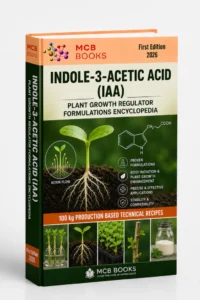
The INDOLE-3-ACETIC ACID (IAA) PLANT GROWTH REGULATOR FORMULATIONS ENCYCLOPEDIA provides comprehensive technical information about IAA formulation design, raw material functions, manufacturing processes, stabilization methods, quality control, application principles, and commercial production. It is designed as a practical reference for agrochemical manufacturers, formulation specialists, agricultural consultants, researchers, tissue culture laboratories, and companies developing professional auxin-based plant growth regulator products.