Fruit enlargement plant growth regulators are specialized agricultural products developed to support fruit size, cell division, cell expansion, fruit development, uniformity, quality, and marketable crop yield. For commercial manufacturers, 100 kg fruit enlargement plant growth regulator formulas provide a practical production scale for developing professional agricultural products suitable for different fruit crops and application programs.
Fruit enlargement formulations can be based on different plant growth regulator active ingredients depending on the desired physiological response. Common examples may include Forchlorfenuron (CPPU), 6-Benzylaminopurine (6-BA/BAP), Gibberellic Acid (GA3), Gibberellins such as GA4+7, and other approved plant growth regulators. The selection of the active ingredient depends on crop species, fruit development stage, intended effect, formulation type, and applicable agricultural regulations.
A typical 100 kg formulation contains the selected active ingredient together with suitable solvents, co-solvents, carriers, surfactants, wetting agents, dispersing agents, emulsifiers, stabilizers, preservatives, buffers, rheology modifiers, and antifoaming agents. Every ingredient has a specific role in maintaining product stability, improving dilution characteristics, ensuring uniform distribution of the active material, and supporting effective application to the crop.
One of the main objectives of fruit enlargement formulations is increasing fruit size through controlled cell division and cell expansion. Cytokinin-type plant growth regulators such as CPPU and 6-BA are particularly associated with cell division, while selected gibberellins can influence cell elongation and fruit development. Formulation design can therefore vary considerably according to the targeted physiological response.
During the manufacture of a 100 kg batch, the carrier or solvent phase is normally prepared first in a suitable production vessel. The active ingredient is incorporated under controlled mixing, followed by surfactants, stabilizers, dispersing agents, and other formulation auxiliaries. Depending on the formulation, high-shear homogenization, milling, controlled dissolution, filtration, or particle-size adjustment may also be required.
Commercial formulations can be developed as soluble concentrates, suspension concentrates, emulsifiable concentrates, water-based concentrates, or other specialized agricultural formulation systems. The selected formulation type should provide adequate storage stability and allow the product to disperse or dissolve uniformly when diluted with water.
Fruit enlargement plant growth regulators are associated with crop-management programs for grapes, kiwifruit, apples, pears, citrus fruits, melons, berries, and various other commercial fruit crops. Proper application timing is essential because treatment during flowering, fruit set, early cell division, or later fruit development stages can produce different responses. Concentration, cultivar, temperature, nutritional conditions, and crop-management practices can also influence final results.
Quality control of 100 kg commercial batches may include testing for active ingredient content, appearance, pH, density, viscosity, solubility, dispersibility, particle size, suspension stability, emulsion stability, dilution performance, temperature stability, and packaging compatibility. These controls are important for maintaining consistent quality from one production batch to another.
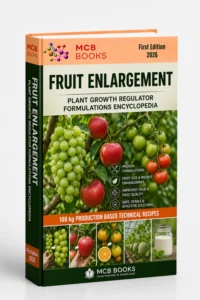
The FRUIT ENLARGEMENT PLANT GROWTH REGULATOR FORMULATIONS ENCYCLOPEDIA provides detailed technical information about 100 kg production formulas, raw material functions, formulation technologies, manufacturing methods, application concepts, and quality-control requirements. It is designed as a practical resource for agrochemical manufacturers, formulation specialists, agricultural consultants, researchers, and companies developing professional products for fruit enlargement, improved fruit quality, and higher marketable crop yield.