 High-quality fertigation fertilizers are essential for modern agricultural systems that combine irrigation and plant nutrition. These fertilizers are applied through drip irrigation, sprinkler irrigation, hydroponic units, and other controlled watering systems. Their main purpose is to deliver nutrients directly to the plant root zone in a soluble and readily available form. Manufacturing reliable fertigation fertilizers requires professional formulation, compatible raw materials, controlled production procedures, and comprehensive quality testing.
The first step in fertigation fertilizer production is identifying the nutritional purpose of the product. Manufacturers may develop balanced NPK fertilizers, high-nitrogen fertilizers, rooting products, flowering fertilizers, high-potassium fruit-development formulations, calcium fertilizers, magnesium products, or micronutrient blends. The nutrient ratio should be selected according to the target crop, growth stage, growing medium, soil properties, and irrigation water quality.
Raw material quality is one of the most important factors affecting fertilizer performance. Fertilizer-grade ingredients should have high purity, good water solubility, controlled moisture content, and consistent nutrient analysis. Common materials include urea, potassium nitrate, calcium nitrate, monoammonium phosphate, monopotassium phosphate, magnesium sulfate, phosphoric acid, trace-element salts, and chelated micronutrients.
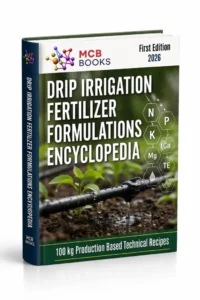
The Drip Irrigation Fertilizer Formulations Encyclopedia provides practical information about professional fertigation fertilizer formulas, raw material functions, production methods, product specifications, and application principles. The book is designed for fertilizer manufacturers, agricultural chemical companies, technical specialists, investors, and entrepreneurs who want to develop commercial plant nutrition products.
Chemical compatibility must be evaluated before ingredients are combined. Calcium sources can react with phosphates and sulfates, creating insoluble compounds. Micronutrients may also react with carbonates, hydroxides, or phosphates and form sediment. These reactions can reduce nutrient availability and clog filters, irrigation pipes, or drip emitters. Incompatible nutrients are therefore often separated into A and B stock solutions.
Water quality is especially important in liquid fertilizer manufacturing. Purified, softened, or demineralized water is generally preferred. Water containing high levels of bicarbonates, calcium, magnesium, iron, or suspended solids may cause precipitation, cloudiness, crystallization, and reduced storage stability. The production water should be tested before formulation work begins.
During liquid fertilizer production, water is transferred into a corrosion-resistant mixing tank and agitation is started. Raw materials are added gradually in the correct sequence. Each component should dissolve completely before another ingredient is introduced. Mixing speed, product temperature, pH, dissolution time, and addition order must be monitored carefully. The finished product may be filtered before packaging to remove undissolved particles.
Water-soluble powder fertilizers require accurate weighing, sieving, blending, moisture control, and particle-size management. Hygroscopic ingredients should be protected from atmospheric moisture because they may cause caking and reduce product flowability. Anti-caking agents may be used when technically suitable.
The Drip Irrigation Fertilizer Formulations Encyclopedia also helps readers understand how different fertilizer types can be developed for vegetables, greenhouse crops, fruit trees, field crops, nurseries, ornamentals, and hydroponic cultivation. Its production-oriented structure can support both product development and commercial manufacturing planning.
Quality-control testing should include nutrient analysis, pH, density, electrical conductivity, appearance, solubility, dilution stability, precipitation resistance, crystallization tendency, moisture content, and storage stability. Fertilizers should dissolve rapidly and remain stable under their recommended storage and application conditions.
Packaging materials must be compatible with concentrated nutrient solutions or soluble powders. Labels should include guaranteed nutrient analysis, application rates, dilution instructions, storage conditions, safety information, batch numbers, and manufacturing dates.
By using high-purity ingredients, compatible nutrient combinations, controlled manufacturing procedures, and reliable quality-control methods, producers can manufacture efficient and stable fertigation fertilizers. Professional fertigation products can improve nutrient-use efficiency, support crop development, reduce fertilizer losses, and create valuable commercial opportunities in modern agriculture.