How Plant Growth Inhibitors Improve Fruit Quality, Yield and Plant Strength
Plant growth inhibitors are widely used in modern agriculture to improve crop quality, increase yield efficiency, and strengthen overall plant structure. As commercial farming systems continue to focus on productivity and export-quality produce, the use of professional plant growth inhibitor formulations has become increasingly important in fruit production, greenhouse cultivation, vegetables, cereals, and ornamental crops.
Plant growth inhibitors work by regulating plant hormone activity, especially gibberellin biosynthesis, which directly affects stem elongation and excessive vegetative growth. By slowing uncontrolled plant expansion, these products help plants redirect energy toward fruit development, root strengthening, flowering performance, and nutrient efficiency. This balanced growth structure results in healthier crops with improved commercial value.
One of the biggest advantages of plant growth inhibitors is their ability to improve fruit quality. Controlled vegetative growth allows plants to allocate more nutrients and carbohydrates to developing fruits instead of excessive leaf and stem production. This often leads to larger fruit size, improved color development, better firmness, enhanced sugar accumulation, and more uniform maturation. In export-oriented agriculture, fruit appearance and shelf life are critical factors, making growth inhibitor technologies highly valuable for commercial producers.
Plant growth inhibitors also contribute significantly to higher crop yields. Stronger stems and compact plant structures reduce lodging risks and improve the plant’s ability to support heavy fruit loads. Improved air circulation and better light penetration inside the canopy can also increase photosynthetic efficiency while reducing disease pressure in dense crop systems. These factors help maintain stable production under intensive agricultural conditions.
In greenhouse production, plant growth inhibitors are especially useful for maintaining compact crop development and maximizing space utilization. Controlled plant size simplifies harvesting, spraying, pruning, and general crop management while improving greenhouse production efficiency. Crops such as tomatoes, peppers, cucumbers, strawberries, ornamentals, and fruit trees commonly benefit from advanced plant growth inhibitor technologies.
Industrial plant growth inhibitor formulations are typically manufactured as soluble concentrates, suspension concentrates, emulsifiable concentrates, or wettable powders depending on crop requirements and application methods. Professional formulations may include active ingredients such as paclobutrazol, chlormequat chloride, daminozide, or mepiquat chloride together with surfactants, stabilizers, solvents, and dispersing systems to improve biological performance and storage stability.
As modern agriculture increasingly demands higher quality and more efficient crop management systems, plant growth inhibitors continue to play a critical role in sustainable agricultural production.
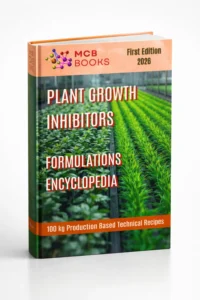
The Plant Growth Inhibitors Formulations Encyclopedia provides professional industrial formulation systems for plant growth inhibitors used in agriculture and greenhouse production. The encyclopedia includes commercial recipes, raw material details, CAS numbers, manufacturing methods, and advanced agrochemical formulation technologies for manufacturers worldwide.