Baby wet wipes are water-based personal care products developed for diaper changes, daily cleansing, travel, and general baby hygiene. Although the finished product may appear simple, a professional baby wet wipes formulation contains several carefully selected raw materials. Each ingredient has a specific function related to cleansing, moisturizing, preservation, skin conditioning, pH control, stability, or sensory performance.
Purified water is normally the main raw material used in baby wet wipes production. It acts as the carrier for the other ingredients and usually represents the largest percentage of the lotion. Water quality is extremely important because minerals, microorganisms, or impurities may negatively affect product stability and safety. For this reason, manufacturers often use reverse-osmosis-treated, deionized, or purified water.
Mild surfactants are added to improve cleansing performance. These ingredients help remove dirt, oily residues, and impurities from the skin. Baby wipes require gentle surfactants that can cleanse without producing excessive foam or leaving an uncomfortable residue. The selected cleansing agents should also be compatible with sensitive baby skin and the other formulation ingredients.
Humectants are used to help maintain moisture on the skin. Glycerin is one of the most common examples. It can reduce the drying effect of repeated cleansing and improve the soft feel of the finished product. Other moisturizing ingredients may also be included depending on the desired performance and marketing concept.
Emollients and skin-conditioning agents are added to improve softness and provide a smoother after-feel. These raw materials can support premium, moisturizing, or sensitive-skin baby wipe formulations. Because many emollients are oil-soluble, they may require suitable solubilizers or emulsifiers to remain evenly distributed in the water-based lotion.
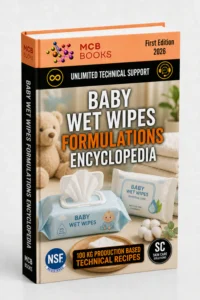
The BABY WET WIPES FORMULATIONS ENCYCLOPEDIA explains how different raw material groups can be combined to create professional wet wipes lotions. It provides practical guidance for manufacturers developing newborn wipes, moisturizing baby wipes, fragrance-free products, herbal wipes, and hypoallergenic formulations.
Soothing ingredients are frequently used in baby wet wipes designed for sensitive skin. Panthenol, allantoin, aloe vera, chamomile extract, calendula extract, cucumber extract, and oat-derived ingredients are common examples. These materials may support soothing, moisturizing, refreshing, or skin-conditioning product claims. However, their concentrations must be carefully controlled because botanical extracts may affect color, odor, clarity, preservation, and stability.
Preservatives are among the most important raw materials in baby wet wipes production. Wet wipes contain a high percentage of water and may be exposed to air and repeated handling after opening. An effective preservative system helps protect the product against bacteria, yeast, and mold. Preservative selection depends on the lotion pH, packaging, nonwoven material, formulation composition, shelf-life expectations, and applicable regulations.
Chelating agents may be added to improve formulation stability and preservative performance. These ingredients bind certain metal ions that may otherwise contribute to discoloration, oxidation, instability, or reduced preservative effectiveness.
pH regulators are used to adjust the lotion to a suitable and consistent pH range. Citric acid, sodium citrate, lactic acid, or similar ingredients may be selected depending on the formulation. Proper pH control is important for skin compatibility, product stability, and preservative performance.
Fragrance is optional in baby wet wipes production. It can improve the sensory appeal of the product, but fragrance-free formulations are often preferred for newborns and babies with highly sensitive skin. When fragrance is used, a compatible solubilizer may be necessary to distribute it evenly throughout the water-based lotion.
The nonwoven fabric is also a major raw material. It should be soft, absorbent, strong when wet, and capable of holding and releasing the lotion effectively. Viscose, polyester, cotton-based fibers, and biodegradable materials may be selected according to cost, performance, softness, and sustainability objectives.
The BABY WET WIPES FORMULATIONS ENCYCLOPEDIA supports producers by providing information about raw material functions, formulation structure, production methods, and quality control. Successful baby wet wipes manufacturing depends on understanding how every ingredient interacts with the lotion, fabric, preservative system, and packaging. With the correct raw materials and a professionally balanced formula, manufacturers can produce gentle, stable, safe, and commercially competitive baby wet wipes.