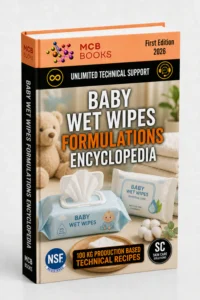
Baby wet wipes are widely used for diaper changes, face and hand cleansing, travel, and daily baby hygiene. As demand for convenient and gentle baby care products continues to grow, many entrepreneurs and manufacturers are interested in establishing a baby wet wipes production facility. Successful commercial production requires professionally developed 100 kg baby wet wipes solution production formulas, suitable manufacturing equipment, hygienic production conditions, quality raw materials, and reliable packaging systems.
A baby wet wipes solution is a water-based lotion applied to soft nonwoven fabric. Purified water normally represents the largest part of the formulation. Additional ingredients may include mild surfactants, humectants, emollients, soothing agents, preservatives, chelating agents, pH regulators, botanical extracts, solubilizers, and optional fragrance materials.
Preparing formulas on a 100 kg basis provides an important advantage for industrial production. The quantities are easy to calculate, scale, compare, and adapt for different batch sizes. For example, a 100 kg formula can be converted into a 1,000 kg production batch by multiplying the quantity of every raw material by ten. However, scaling should always be supported by suitable mixing capacity, process control, and production trials.
The BABY WET WIPES FORMULATIONS ENCYCLOPEDIA provides structured formulation information for manufacturers seeking practical baby wet wipes production formulas. It can support the development of alcohol-free, paraben-free, fragrance-free, hypoallergenic, moisturizing, botanical, newborn, and extra-sensitive baby wipes.
Preparation of a 100 KG Baby Wet Wipes Solution
Production normally begins by transferring purified water into a clean stainless-steel mixing tank. Water-soluble raw materials are added gradually under controlled agitation. Humectants, chelating agents, mild cleansing ingredients, preservatives, and skin-conditioning agents should be incorporated in the correct sequence.
Oil-soluble emollients, fragrances, or certain botanical ingredients may require a suitable solubilizer or emulsifier. Excessive agitation should be avoided if it creates high levels of foam. Heat-sensitive ingredients are generally added during the cooling stage when heating is required for dissolving other raw materials.
After mixing, the baby wet wipes solution should be tested for appearance, odor, pH, viscosity, density, clarity, stability, and microbiological quality. Preservative efficacy testing is especially important because wet wipes contain a high percentage of water and may be exposed to contamination after the package is opened.
Equipment Required for a Baby Wet Wipes Production Facility
A professional baby wet wipes production facility may require purified water equipment, stainless-steel mixing tanks, transfer pumps, filtration units, lotion storage tanks, nonwoven fabric unwinding systems, folding and cutting machines, lotion dosing equipment, packaging machines, coding systems, and quality control instruments.
The selected production line should match the planned product type and daily production capacity. Machines may be designed for single wipes, travel packs, soft packs, flow packs, canisters, or refill packages. Accurate lotion dosing is essential because insufficient liquid may produce dry wipes, while excessive liquid can cause leakage and packaging problems.
Facility Design and Hygiene Requirements
The production area should be organized to reduce contamination risks and support an efficient manufacturing flow. Raw material storage, lotion preparation, nonwoven processing, packaging, finished-product storage, and quality control areas should be clearly separated.
Mixing tanks, pipelines, filling systems, and product-contact surfaces must be cleaned and sanitized according to documented procedures. Employee hygiene, purified water quality, air cleanliness, pest control, waste management, and raw material traceability are also important parts of a professional manufacturing system.
Nonwoven Fabric and Packaging Selection
The nonwoven material should be soft, absorbent, strong when wet, and suitable for sensitive baby skin. Viscose, polyester, cotton-based fibers, and biodegradable materials may be used depending on the desired performance, price level, and environmental positioning.
Packaging should prevent moisture loss, protect the product from contamination, and allow convenient use. Resealable labels and plastic lids are frequently used to keep the wipes moist after opening.
The BABY WET WIPES FORMULATIONS ENCYCLOPEDIA offers valuable technical guidance related to 100 kg production formulas, raw material functions, manufacturing methods, application information, and commercial product development. Establishing a successful baby wet wipes production facility requires more than purchasing machinery. Manufacturers must combine reliable formulations, controlled production procedures, hygienic equipment, appropriate nonwoven fabric, protective packaging, and consistent quality testing.
With professional formulation knowledge and an organized production system, companies can manufacture stable, gentle, and commercially competitive baby wet wipes for private-label brands, domestic markets, and international customers.