 Liquid fertilizers for drip irrigation systems have become essential products in modern agriculture because they allow water and plant nutrients to be delivered directly to the root zone. This method, commonly known as fertigation, supports efficient nutrient use, reduces fertilizer losses, and helps growers manage crop nutrition more accurately. Producing high-quality liquid fertilizers for drip irrigation requires careful formulation, suitable raw materials, controlled manufacturing procedures, and detailed quality testing.
The first stage of liquid fertilizer production is determining the intended nutrient composition. A fertigation product may contain nitrogen, phosphorus, potassium, calcium, magnesium, sulfur, and essential micronutrients such as iron, zinc, manganese, copper, boron, and molybdenum. The selected nutrient ratio should match the target crop, growth stage, soil characteristics, irrigation water quality, and climatic conditions.
Raw material solubility is one of the most important factors in drip irrigation fertilizer formulation. Materials that do not dissolve completely can create sediment, block filters, and clog irrigation emitters. Highly soluble raw materials such as urea, potassium nitrate, ammonium nitrate, monoammonium phosphate, phosphoric acid, potassium hydroxide, and selected micronutrient chelates are commonly used. However, every ingredient must be checked for chemical compatibility before production.
Calcium-based raw materials should not normally be combined in highly concentrated solutions with phosphates or sulfates because insoluble precipitates may form. For this reason, some commercial fertigation programs use separate A and B tanks. Calcium nitrate and iron chelates may be placed in one tank, while phosphate, sulfate, magnesium, potassium, and other nutrients are placed in another. This separation helps protect fertilizer stability and irrigation system performance.
Water quality also directly affects liquid fertilizer production. Purified, softened, or demineralized water is generally preferred for concentrated products. High levels of calcium, magnesium, bicarbonates, carbonates, or suspended solids in production water may cause turbidity and sediment formation. The water should therefore be analyzed before manufacturing begins.
During production, a measured amount of water is transferred into a stainless-steel or chemically resistant mixing tank. Agitation is started at a controlled speed. Raw materials are then added gradually according to their solubility and compatibility. Highly soluble nutrient salts are usually dissolved first, followed by acids, chelating agents, trace elements, stabilizers, and pH-adjusting materials. Each ingredient should dissolve completely before the next component is introduced.
The temperature of the mixture must also be monitored. Some materials dissolve more easily in moderately warm water, but excessive heat can damage sensitive ingredients or affect storage stability. After all components are added, the batch is mixed until a clear and uniform solution is obtained. The final product may then be filtered to remove undissolved particles.
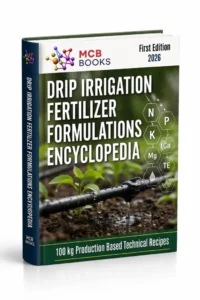
The Drip Irrigation Fertilizer Formulations Encyclopedia provides practical fertilizer production formulas, raw material functions, manufacturing procedures, product specifications, and technical application information. It can help fertilizer producers, agricultural chemical companies, technical specialists, and entrepreneurs understand the basic principles of commercial fertigation product development.
Quality control is necessary before packaging. Important tests include pH, density, electrical conductivity, nutrient content, appearance, solubility, crystallization resistance, dilution stability, and storage stability. The fertilizer should remain homogeneous under recommended storage conditions and should dissolve safely when introduced into irrigation water.
Packaging materials must be resistant to acids, salts, and concentrated nutrient solutions. High-density polyethylene containers are commonly used for commercial liquid fertilizers. Labels should include guaranteed nutrient analysis, dilution instructions, storage conditions, safety precautions, batch information, and recommended application rates.
By following professional production procedures and compatible formulation principles, manufacturers can develop stable and effective liquid fertilizers for drip irrigation systems. The Drip Irrigation Fertilizer Formulations Encyclopedia serves as a valuable technical guide for businesses seeking to produce reliable fertigation fertilizers and expand their agricultural product portfolio.