 Drip irrigation fertilizer production requires a combination of professional formulation knowledge, suitable raw material selection, controlled manufacturing procedures, and reliable quality testing. Fertilizers used in drip irrigation and fertigation systems must dissolve easily, remain chemically stable, and pass through filters, pipes, and emitters without causing sediment or blockage. For this reason, manufacturers must follow detailed technical guidelines during product development and commercial production.
The first stage of drip irrigation fertilizer production is determining the intended nutrient composition. Manufacturers may develop balanced NPK fertilizers, high-nitrogen growth fertilizers, high-phosphorus rooting products, high-potassium flowering and fruit-development fertilizers, calcium solutions, magnesium fertilizers, or micronutrient blends. The formula should be designed according to the target crop, plant growth stage, soil characteristics, irrigation water quality, and application method.
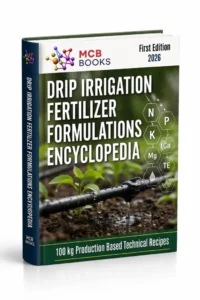
The Drip Irrigation Fertilizer Formulations Encyclopedia provides production-oriented information for fertilizer manufacturers, agricultural chemical companies, entrepreneurs, investors, and technical personnel. The book contains professional fertilizer formulas, raw material functions, manufacturing methods, technical specifications, product characteristics, and application guidelines for different fertigation products.
Raw material solubility is one of the most important technical criteria. Common ingredients may include urea, potassium nitrate, calcium nitrate, ammonium sulfate, monoammonium phosphate, monopotassium phosphate, magnesium sulfate, phosphoric acid, potassium hydroxide, trace-element salts, chelating agents, organic acids, and purified water. High-purity fertilizer-grade raw materials are generally preferred because insoluble impurities can reduce product quality and damage irrigation equipment.
Chemical compatibility must be evaluated before production begins. Calcium-containing materials can react with phosphate or sulfate sources and form insoluble precipitates. Micronutrients may also react with carbonates, hydroxides, or phosphates. In concentrated fertigation programs, incompatible nutrients are often separated into A and B stock solutions. This method reduces precipitation risk and helps maintain nutrient availability.
Liquid fertilizer production usually begins by transferring purified or demineralized water into a corrosion-resistant mixing tank. Agitation is started at a controlled speed, and the raw materials are added gradually according to their solubility and compatibility. Each ingredient should dissolve completely before the next material is introduced. Acids must always be added carefully to water under controlled conditions and with appropriate personal protective equipment.
Production temperature should be monitored because some nutrient salts create heat during dissolution. Excessive temperatures may affect sensitive ingredients, chelating agents, or storage stability. After all materials are added, the solution is mixed until it becomes uniform. The finished fertilizer may then be filtered to remove undissolved particles before packaging.
Water-soluble powder fertilizers require a different production method. Raw materials are accurately weighed, sieved, and blended until a homogeneous mixture is obtained. Moisture control is essential because many fertilizer salts are hygroscopic and may absorb water from the atmosphere. This can cause caking, reduced flowability, and difficulty during dissolution. Suitable anti-caking agents and moisture-resistant packaging may therefore be required.
The Drip Irrigation Fertilizer Formulations Encyclopedia also explains how professional 100 kg fertilizer formulas can support batch calculations and commercial production planning. A 100 kg formula allows manufacturers to interpret each ingredient amount as a percentage and simplifies scaling to larger production batches.
Quality-control procedures should include nutrient analysis, pH, density, electrical conductivity, appearance, solubility, dilution stability, crystallization resistance, precipitation testing, moisture content, and storage stability. Manufacturers should also test the fertilizer with different irrigation water samples to evaluate its performance under realistic application conditions.
Packaging materials must be compatible with concentrated fertilizer solutions or water-soluble powders. Product labels should clearly state the guaranteed nutrient analysis, application rates, dilution instructions, storage conditions, safety precautions, batch number, and manufacturing date.
By following professional production methods and technical guidelines, manufacturers can develop stable, soluble, and commercially successful fertilizers for drip irrigation systems. The Drip Irrigation Fertilizer Formulations Encyclopedia serves as a practical technical reference for companies seeking to improve fertilizer quality, expand their product range, and meet the growing demands of modern fertigation and precision agriculture.