Drip irrigation fertilizer formulations are an essential part of modern agriculture because they enable nutrients to be delivered directly to the plant root zone through irrigation water. This technique, known as fertigation, can improve nutrient-use efficiency, reduce fertilizer losses, support uniform crop growth, and provide growers with greater control over plant nutrition. Manufacturing high-quality fertilizers for drip irrigation requires professional formulation knowledge, soluble raw materials, controlled production procedures, and reliable quality testing.
The first step in developing a drip irrigation fertilizer is determining the nutritional purpose of the product. Fertilizers may be formulated for vegetative growth, root development, flowering, fruit formation, ripening, stress resistance, or the correction of specific nutrient deficiencies. Manufacturers can produce balanced NPK fertilizers, high-nitrogen products, high-phosphorus rooting fertilizers, high-potassium fruit-development formulas, calcium solutions, magnesium fertilizers, and micronutrient blends.
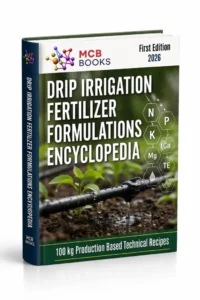
The Drip Irrigation Fertilizer Formulations Encyclopedia provides practical information for fertilizer manufacturers, agricultural chemical companies, entrepreneurs, investors, and technical specialists. The book includes professional production formulas, raw material functions, manufacturing processes, technical specifications, product characteristics, and application guidance for different fertigation products.
Raw material selection is one of the most important stages of fertilizer formulation. Common ingredients include urea, potassium nitrate, calcium nitrate, ammonium sulfate, monoammonium phosphate, monopotassium phosphate, magnesium sulfate, phosphoric acid, potassium hydroxide, chelated trace elements, organic acids, stabilizers, and purified water. Fertilizer-grade materials should have high purity, consistent nutrient content, good water solubility, and low levels of insoluble impurities.
Chemical compatibility must be carefully evaluated before production. Calcium-containing ingredients may react with phosphates or sulfates and form insoluble compounds. Micronutrients can also react with carbonates, hydroxides, or phosphates, reducing nutrient availability and producing sediment. In concentrated fertigation systems, incompatible nutrients are often separated into A and B stock solutions to prevent precipitation and emitter blockage.
Water quality also has a major influence on fertilizer stability. Production water should be tested for hardness, pH, bicarbonates, calcium, magnesium, iron, salinity, and suspended particles. Purified, softened, or demineralized water is generally preferred for concentrated liquid fertilizers because poor-quality water can cause cloudiness, crystallization, or sediment formation.
Liquid fertilizer manufacturing normally begins by adding water to a corrosion-resistant mixing tank. Agitation is started, and raw materials are introduced gradually in the correct sequence. Each ingredient should dissolve completely before the next component is added. Mixing speed, temperature, pH, dissolution time, and addition order should be controlled throughout the production process. The finished fertilizer may then be filtered before packaging.
Water-soluble powder fertilizer manufacturing requires accurate weighing, sieving, particle-size control, homogeneous blending, and moisture protection. Many fertilizer salts are hygroscopic and can absorb moisture from the air, leading to caking and reduced flowability. Suitable anti-caking materials and moisture-resistant packaging may therefore be required.
The Drip Irrigation Fertilizer Formulations Encyclopedia also explains how 100 kg production formulas can simplify batch calculations and commercial manufacturing. In a 100 kg formula, each kilogram directly represents one percent of the finished product, making it easier to calculate larger production quantities. However, pilot production and stability testing should always be completed before industrial scaling.
Quality-control tests may include nutrient analysis, pH, density, electrical conductivity, solubility, appearance, dilution stability, moisture content, crystallization tendency, precipitation resistance, and storage stability. Fertilizers should also be tested with different irrigation water samples to confirm their suitability for real agricultural conditions.
Proper packaging and labeling are equally important. Product labels should provide guaranteed nutrient analysis, application rates, dilution instructions, storage conditions, safety precautions, batch numbers, and manufacturing dates.
The Drip Irrigation Fertilizer Formulations Encyclopedia serves as a comprehensive technical guide for businesses seeking to develop stable, effective, and commercially applicable fertigation fertilizers. By combining professional formulations, compatible raw materials, controlled manufacturing methods, and quality assurance, producers can create reliable fertilizer products for greenhouse crops, orchards, field crops, nurseries, and hydroponic cultivation.