 Crop-specific foliar fertilizer formulations are developed to meet the nutritional requirements of particular crops, growth stages, soil conditions, and agricultural production systems. Unlike general-purpose fertilizers, these specialized products contain carefully selected combinations of nitrogen, phosphorus, potassium, secondary nutrients, micronutrients, amino acids, and other plant-supporting components. Their purpose is to provide targeted nutrition through leaf surfaces, correct nutrient deficiencies, improve plant development, and support higher yield and crop quality.
The nutrient requirements of plants vary considerably according to crop type and development stage. Cereals such as wheat, maize, and barley may require nitrogen-rich foliar fertilizers during vegetative growth, followed by balanced micronutrient applications during grain development. Vegetable crops often benefit from formulations containing potassium, magnesium, calcium, boron, zinc, and manganese. Fruit trees and vineyards may require specialized products for flowering, fruit setting, fruit enlargement, color formation, sugar accumulation, and post-harvest quality.
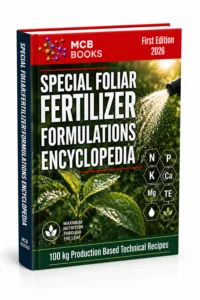
The SPECIAL FOLIAR FERTILIZER FORMULATIONS ENCYCLOPEDIA provides practical technical guidance for developing crop-specific fertilizer products for professional agricultural markets. Manufacturers can create formulations for tomatoes, potatoes, citrus fruits, grapes, olives, apples, strawberries, cotton, cereals, greenhouse vegetables, and many other crops. Each formula should be designed according to crop physiology, nutrient demand, local climate, irrigation water quality, and expected yield.
Nitrogen supports chlorophyll formation, vegetative development, and protein synthesis. Phosphorus contributes to energy transfer, flowering, root development, and early plant establishment. Potassium helps regulate water movement, enzyme activity, fruit quality, stress tolerance, and ripening. Secondary nutrients such as calcium, magnesium, and sulfur may improve tissue strength, chlorophyll production, and metabolic activity. Micronutrients including iron, zinc, manganese, copper, boron, and molybdenum perform essential functions in photosynthesis, flowering, enzyme systems, and nitrogen metabolism.
Crop-specific foliar fertilizer formulations may also contain chelating agents, amino acids, seaweed extracts, organic acids, wetting agents, surfactants, stabilizers, and pH regulators. Chelated micronutrients such as EDTA- or DTPA-based compounds can improve solubility and stability. Surfactants help the spray solution spread more evenly across leaf surfaces, while suitable stabilizers reduce sediment formation during storage.
Commercial production requires clean process water, accurate weighing, controlled mixing, suitable addition order, pH adjustment, filtration, and quality testing. Finished products should be evaluated for nutrient content, density, appearance, solubility, sediment formation, dilution stability, and storage performance.
The SPECIAL FOLIAR FERTILIZER FORMULATIONS ENCYCLOPEDIA can support fertilizer manufacturers, agricultural engineers, researchers, consultants, production managers, and entrepreneurs seeking to develop specialized plant nutrition products. Reliable formulations can help companies expand their product range and serve different crop markets more effectively.
With production-focused formulas, raw material information, manufacturing instructions, and technical specifications, the SPECIAL FOLIAR FERTILIZER FORMULATIONS ENCYCLOPEDIA is a valuable reference for producing stable, effective, and marketable crop-specific foliar fertilizers for higher yield and improved crop quality.