 Quality control is essential in commercial foliar fertilizer manufacturing because the finished product must remain homogeneous, soluble, stable, and suitable for application through agricultural spraying equipment. Foliar fertilizers may contain macronutrients, secondary nutrients, micronutrients, chelated elements, amino acids, seaweed extracts, surfactants, stabilizers, and other functional additives. Every ingredient and production stage can influence nutrient content, appearance, storage stability, leaf safety, and overall product performance.
Quality assurance begins with the inspection of incoming raw materials. Nutrient salts, chelated micronutrients, organic ingredients, preservatives, pH regulators, and process water should be checked for identity, purity, concentration, solubility, moisture, color, odor, and contamination. Certificates of analysis should be reviewed, and representative samples should be retained when appropriate. Variations in raw material quality may alter the declared nutrient analysis or cause sedimentation, crystallization, discoloration, and incompatibility.
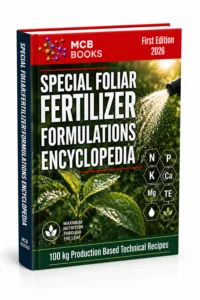
The SPECIAL FOLIAR FERTILIZER FORMULATIONS ENCYCLOPEDIA provides practical information about raw material selection, formulation design, production procedures, and technical product requirements. During manufacturing, accurate weighing and controlled addition order are necessary to maintain batch consistency. Mixing speed, temperature, dissolution time, and pH should be monitored and recorded. Each ingredient must dissolve or disperse properly before the following component is introduced.
The pH specification is particularly important because it affects micronutrient solubility, chelate stability, preservative performance, and compatibility between ingredients. Density should also be measured because it helps verify formulation consistency and correct filling weight. Other important physical specifications include appearance, color, odor, clarity, viscosity where relevant, and the absence of visible sediment or crystals.
Chemical analysis should confirm the declared levels of nitrogen, phosphorus, potassium, calcium, magnesium, sulfur, iron, zinc, manganese, copper, boron, molybdenum, or other nutrients included in the product. Testing methods and acceptable tolerances should comply with applicable regulations and internal quality standards in the target market.
Filtration quality is another critical parameter. Insoluble particles may block spray nozzles and reduce customer satisfaction. Finished products should therefore be evaluated for filtration behavior, dilution stability, water compatibility, foaming tendency, sediment formation, and crystallization under different storage temperatures.
The SPECIAL FOLIAR FERTILIZER FORMULATIONS ENCYCLOPEDIA also supports the development of stability-testing programs. Samples may be stored at low, ambient, and elevated temperatures to observe changes in pH, density, color, odor, precipitation, phase separation, and packaging compatibility. Containers, caps, seals, and labels should resist leakage, deformation, corrosion, and product interaction.
Batch records should include raw material lot numbers, quantities, processing conditions, test results, packaging details, and corrective actions. The SPECIAL FOLIAR FERTILIZER FORMULATIONS ENCYCLOPEDIA is a valuable technical reference for manufacturers, agricultural engineers, laboratory personnel, production managers, and entrepreneurs seeking to produce consistent, stable, and marketable foliar fertilizer products for professional agriculture.