The global transition toward sustainable agriculture, reduced chemical pesticide use, and integrated pest management has increased demand for commercial microbial biopesticide production. Agricultural companies are increasingly interested in biological crop protection products based on beneficial microorganisms that can help control insects, plant pathogens, and other agricultural pests. However, developing a successful commercial product requires much more than selecting an effective microorganism. Manufacturers need practical knowledge about formulation technology, raw materials, fermentation, stabilization, quality control, packaging, and industrial production methods.
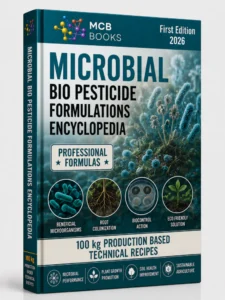
The MICROBIAL BIO PESTICIDE FORMULATIONS ENCYCLOPEDIA is designed as a practical technical resource for companies, entrepreneurs, formulation specialists, agricultural input manufacturers, and R&D departments planning to develop and manufacture microbial biopesticide products.
Commercial microbial biopesticides may contain microorganisms such as Bacillus thuringiensis, Bacillus subtilis, Trichoderma species, Beauveria bassiana, Metarhizium species, and other microbial biological control agents. Each microorganism has different requirements regarding cultivation conditions, moisture, pH, temperature, oxygen exposure, carrier compatibility, formulation technology, and storage stability. For this reason, commercial product development requires formulation systems specifically adapted to the selected microbial active material.
One of the first stages in industrial microbial biopesticide production is microbial cultivation or fermentation. Depending on the microorganism, manufacturers may use liquid fermentation, solid-state fermentation, or other controlled cultivation methods. Temperature, nutrient composition, aeration, agitation, incubation time, pH, and contamination control must be carefully managed to achieve consistent microbial biomass, viable cells, or spore production.
After fermentation, the microbial material may need to be harvested, concentrated, filtered, dried, or otherwise prepared before formulation. The processing method must protect the biological activity of the microorganism while producing a material suitable for incorporation into a commercial agricultural formulation.
The next stage is biopesticide formulation development. A commercial microbial pesticide usually contains more than the biological active ingredient. Depending on the final product type, formulations may include carriers, fillers, wetting agents, dispersants, suspending agents, stabilizers, protective materials, anti-caking agents, oils, rheology modifiers, moisture-control materials, and other compatible additives.
Microbial biopesticides can be developed in different commercial forms, including liquid concentrates, suspension formulations, wettable powders, water-dispersible powders, oil-based formulations, granules, and carrier-based products. Each formulation type has specific advantages and technical requirements. The selection depends on the microorganism, target pest, crop, application method, production equipment, climate, storage conditions, and commercial market requirements.
The MICROBIAL BIO PESTICIDE FORMULATIONS ENCYCLOPEDIA provides structured formulation information that can help manufacturers understand the role of individual raw materials and how different ingredients contribute to product stability and application performance. Knowing the function of each component is especially important because ingredients suitable for conventional chemical pesticides may not always be compatible with living microbial agents.
Stabilization and shelf-life management are among the most important challenges in commercial microbial biopesticide production. Microorganisms may lose viability when exposed to excessive heat, humidity, unsuitable pH, oxidation, ultraviolet radiation, or incompatible formulation components. Manufacturers must therefore develop production and packaging systems that help maintain biological activity from manufacturing through storage and field application.
Quality control is another essential part of commercial production. Depending on the microorganism and formulation, important quality parameters may include viable microbial count, spore concentration, germination rate, microbial purity, contamination level, biological activity, moisture content, pH, viscosity, particle size, wettability, dispersibility, suspension stability, and storage stability.
Consistent quality standards are particularly important when scaling production from laboratory or pilot batches to larger industrial quantities. Standardized formulation ratios, controlled manufacturing procedures, suitable equipment, and documented production parameters can help reduce batch-to-batch variability.
Packaging must also be selected according to the sensitivity of the formulation. Liquid products may require containers that provide protection from light, oxygen, or leakage, while dry microbial products generally require packaging with effective moisture barriers. Stability testing is necessary to determine realistic storage conditions and shelf-life specifications.
The MICROBIAL BIO PESTICIDE FORMULATIONS ENCYCLOPEDIA brings together practical information about microbial biopesticide formulas, raw materials, production procedures, formulation technologies, fermentation methods, stabilization, quality control, technical specifications, and commercial manufacturing principles.
For companies planning to enter or expand within the biological crop protection industry, this encyclopedia can provide a valuable technical starting point for product development. It is particularly suitable for biopesticide manufacturers, agricultural chemical companies, biological control businesses, formulation laboratories, R&D professionals, start-up manufacturers, investors, and technical consultants.
By combining formulation knowledge with industrial manufacturing principles, the MICROBIAL BIO PESTICIDE FORMULATIONS ENCYCLOPEDIA helps users better understand how microbial active materials can be transformed into stable, practical, and commercially applicable crop protection products. For manufacturers seeking opportunities in sustainable agriculture, professional microbial biopesticide production represents an important and rapidly developing area of modern agricultural technology.