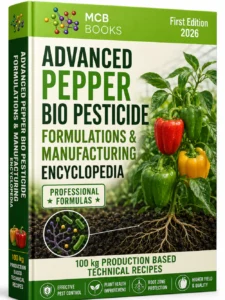
The Advanced Pepper Bio Pesticide Formulations & Manufacturing Encyclopedia is a comprehensive technical resource developed for agricultural manufacturers, formulators, growers, researchers, consultants, and companies interested in biological pest and disease management specifically for pepper crops. Pepper production can be affected by a wide range of insects, mites, fungal diseases, and soil-borne pathogens, making effective crop protection an essential part of commercial production.
Biological pesticides offer an alternative or complementary approach to conventional chemical pesticides and can play an important role in integrated pest management programs. Depending on the intended product, bio pesticide formulations for pepper crops may contain beneficial microorganisms, microbial metabolites, botanical extracts, naturally derived active substances, enzymes, essential oil components, or other biologically active materials.
Common pepper pests include thrips, aphids, whiteflies, mites, caterpillars, leaf miners, and other insects that feed on leaves, flowers, shoots, and developing fruits. These pests may directly damage plants, reduce photosynthetic activity, cause deformation, lower fruit quality, or act as vectors for certain plant diseases. Bio insecticide formulations can be designed to improve contact, spreading, adhesion, and persistence on plant surfaces while maintaining the biological effectiveness of the active ingredient.
Pepper crops are also vulnerable to important diseases including powdery mildew, Botrytis, damping-off, root rot, Fusarium-related diseases, Pythium, Rhizoctonia, and other fungal or fungal-like pathogens. Biological fungicide products may contain beneficial bacteria, fungi, microbial metabolites, botanical substances, or naturally derived antifungal compounds that help suppress pathogen development or support competitive biological activity around the plant and root zone.
The Advanced Pepper Bio Pesticide Formulations & Manufacturing Encyclopedia explains the role of important formulation components such as carriers, wetting agents, dispersing agents, emulsifiers, stabilizers, suspending agents, adhesion enhancers, anti-foaming agents, compatible preservatives, and protective additives. Correct raw material selection is essential because biological active ingredients may be sensitive to unsuitable pH, excessive temperatures, aggressive mixing, incompatible surfactants, or improper storage conditions.
Manufacturing procedures require careful control of water quality, temperature, pH, mixing order, homogenization, and processing time. Microbial formulations often require gentler manufacturing conditions to protect viability, while botanical formulations may need efficient emulsification or dispersion systems to maintain physical stability.
Different product forms can be developed for foliar spraying, soil application, root-zone treatment, seedling application, or integrated greenhouse and open-field pepper production. Liquid concentrates, suspension formulations, microbial preparations, botanical products, and water-dispersible systems can all be designed according to the target pest or disease.
Quality control is a critical part of commercial manufacturing. Parameters such as appearance, pH, viscosity, density, dispersibility, suspension stability, microbial viability where applicable, contamination, storage stability, and biological performance should be evaluated.
The Advanced Pepper Bio Pesticide Formulations & Manufacturing Encyclopedia provides a practical foundation for companies seeking to develop professional biological crop protection solutions for pepper production. By combining formulation knowledge, manufacturing procedures, raw material functions, quality control, and application-oriented product development, it supports modern and sustainable pepper crop protection programs.