 Fruit enlargement plant growth regulators are specialized agricultural products designed to support fruit development, cell division, cell expansion, fruit size, uniformity, and commercial crop quality. Manufacturing these products requires careful formulation planning because the active ingredients used in fruit enlargement programs often need suitable carriers, solvents, surfactants, dispersants, stabilizers, and other functional raw materials to provide consistent storage stability and field performance.
Common active ingredients used in fruit enlargement plant growth regulator formulations may include Forchlorfenuron (CPPU), 6-Benzylaminopurine (6-BA/BAP), gibberellic acid and other selected plant growth regulators, depending on the crop, target effect, formulation type, and local regulatory approvals. Each active ingredient has different solubility, stability, and compatibility characteristics, making raw material selection an essential part of formulation development.
A typical commercial formulation may contain the active plant growth regulator together with suitable solvents or carriers, nonionic surfactants, wetting agents, dispersing agents, emulsifiers, stabilizers, preservatives, antifoaming agents, buffers, and rheology modifiers. These supporting ingredients help maintain uniformity, improve dilution in water, enhance spreading on plant surfaces, and protect the formulation during storage and transportation.
The manufacturing process normally begins by preparing the liquid or carrier phase in a clean stainless-steel production vessel. Water, solvents, co-solvents, stabilizers, and other soluble ingredients are added under controlled agitation. The selected active ingredient is then incorporated gradually. Surfactants, wetting agents, dispersants, emulsifiers, and other functional additives are subsequently introduced until a homogeneous formulation is obtained.
Depending on the product type, additional processing such as high-shear mixing, homogenization, wet milling, filtration, or controlled particle-size reduction may be required. Suspension concentrates, for example, require careful control of particle size and viscosity to minimize sedimentation. Soluble or solvent-based concentrates require complete dissolution and protection against crystallization during storage. Temperature and pH should therefore be monitored throughout production.
Commercial manufacturers must also establish an effective quality-control program. Important parameters may include active ingredient concentration, appearance, pH, density, viscosity, solubility or dispersibility, particle size, suspension or emulsion stability, dilution behavior, low- and high-temperature stability, and packaging compatibility. These tests help ensure batch-to-batch consistency and reliable performance after dilution and application.
Fruit enlargement plant growth regulators may be used in production programs for grapes, kiwifruit, apples, pears, citrus, berries, melons, and other crops where increased fruit size and improved market quality are desired. Application timing, dosage, crop variety, growth stage, environmental conditions, and local label requirements are critical because plant growth regulators can produce substantially different physiological responses depending on how and when they are applied.
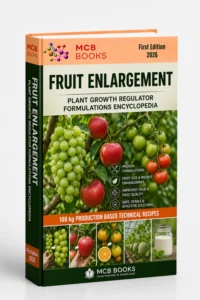
The FRUIT ENLARGEMENT PLANT GROWTH REGULATOR FORMULATIONS ENCYCLOPEDIA provides detailed technical information on formulation principles, raw material functions, manufacturing processes, quality-control methods, application concepts, and commercial production considerations. It serves as a practical reference for agrochemical manufacturers, formulation specialists, researchers, consultants, and companies developing professional fruit enlargement plant growth regulator products for modern agricultural markets.