 The production of alginic acid powder requires a coordinated sequence of industrial equipment designed for raw material preparation, extraction, separation, precipitation, washing, dewatering, drying, milling, and final quality control. Selecting the correct machinery is essential for achieving stable product quality, efficient processing, and reliable production capacity.
The process begins with brown seaweed preparation equipment. Depending on the condition of the raw material, the production line may include washing systems, cleaning units, cutting machines, shredders, and size-reduction equipment. These machines help remove sand, salts, shells, and foreign materials while preparing the seaweed for efficient extraction.
The prepared seaweed is transferred to extraction tanks or reactors equipped with agitation systems. These vessels must provide uniform mixing and controlled operating conditions during alkaline extraction. Pumps, chemical dosing systems, heat exchangers, and temperature-control equipment may also be integrated into the extraction section.
After extraction, the mixture contains both soluble alginate and insoluble seaweed residues. Efficient solid-liquid separation equipment is therefore required. Industrial systems may include screens, filter presses, rotary filters, centrifuges, settling tanks, or other clarification equipment depending on plant scale and process design.
The clarified alginate solution then enters the precipitation stage. Precipitation tanks with controlled chemical dosing and agitation are used to convert soluble alginate into alginic acid. Process control at this stage is important because pH, mixing intensity, reaction time, and chemical addition can influence recovery efficiency and product quality.
Following precipitation, the wet alginic acid is separated and washed. Equipment such as filter presses, centrifuges, washing tanks, and dewatering systems may be used to reduce residual salts and process chemicals.
The dewatered material is then transferred to the drying system. Dryer selection depends on production capacity, product characteristics, energy efficiency, and required final moisture content. After drying, the material passes through mills, grinders, classifiers, and sieving systems to produce a uniform alginic acid powder particle size.
The complete production line also requires storage tanks, transfer pumps, dust-control systems, packaging machinery, wastewater-treatment equipment, laboratory instruments, and process-control systems.
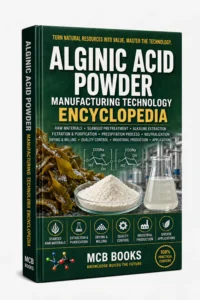
For manufacturers and engineers planning an industrial production line, the ALGINIC ACID POWDER MANUFACTURING TECHNOLOGY ENCYCLOPEDIA provides detailed guidance on process flow, machinery selection, raw material preparation, extraction, separation, precipitation, drying, milling, quality control, troubleshooting, and industrial-scale production.