INTRODUCTION
Didecyl Dimethyl Ammonium Chloride (DDAC) is one of the most effective quaternary ammonium compounds used in modern disinfectant formulations. It provides strong antimicrobial activity against bacteria, fungi, and enveloped viruses, making it widely used in surface disinfectants for industrial, agricultural, and healthcare applications.
In surface disinfectant production, DDAC-based formulations are preferred due to their stability, compatibility with surfactants, and long-lasting residual effect. These properties make DDAC especially suitable for high-contamination environments such as poultry farms, food processing areas, and public hygiene systems.
This article explains the formulation, raw materials, and industrial production process of DDAC-based surface disinfectants.
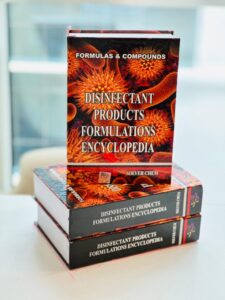
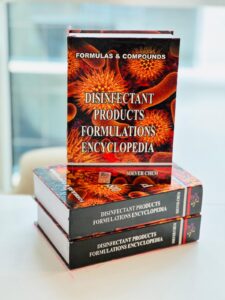
This formulation is included in the Industrial Disinfectant Formulations Encyclopedia, containing real industrial recipes developed by a chemical engineer with 40+ years of experience.
WHAT IS DDAC AND WHY IS IT USED?
DDAC is a quaternary ammonium compound with strong cationic properties. It disrupts microbial cell membranes, leading to rapid and effective disinfection.
Advantages of DDAC:
- Broad-spectrum antimicrobial activity
- Residual disinfectant effect
- Low odor and user-friendly formulation
- Compatibility with surfactants
- Stable in different pH ranges
DDAC-BASED SURFACE DISINFECTANT FORMULA (100 KG)
Raw Material | Function | Amount (kg)
- Didecyl Dimethyl Ammonium Chloride (DDAC 80%) → Active disinfectant → 6 kg
- Nonionic Surfactant (C9-11 Alcohol Ethoxylate) → Wetting agent → 4 kg
- Cocamidopropyl Betaine → Foam booster → 2 kg
- Isopropyl Alcohol → Solvent → 8 kg
- EDTA → Chelating agent → 0.5 kg
- Sodium Carbonate → pH adjuster → 1 kg
- Water → Carrier → 78.5 kg
Total: 100 kg
PRODUCTION PROCESS
The production begins by charging water into a mixing tank equipped with a moderate-speed agitator. EDTA is added first and allowed to dissolve completely to enhance stability and metal ion control.
Nonionic surfactants are then introduced slowly to avoid excessive foaming. Cocamidopropyl betaine is added to improve surface interaction and cleaning performance.
DDAC is added carefully into the system under continuous stirring to ensure uniform distribution. Isopropyl alcohol is introduced in the next stage to improve drying time and enhance antimicrobial efficiency.
The pH is adjusted using sodium carbonate to reach the optimal range for stability and performance. The mixture is stirred for 20–30 minutes until completely homogeneous. The final product is filtered if necessary and filled into suitable packaging.
APPLICATION AREAS
DDAC-based surface disinfectants are widely used in:
- Poultry and livestock farms
- Food processing facilities
- Hospitals and medical equipment surfaces
- Public hygiene areas
- Industrial sanitation systems
For broader formulation knowledge, you can also explore:
- Surface disinfectant formulation and production processes
- Hydrogen peroxide disinfectant systems
- Peracetic acid disinfectant formulations
These resources help build a complete disinfectant production knowledge base.
SUMMARY
DDAC-based surface disinfectants are among the most reliable and widely used antimicrobial solutions in industrial applications. Their strong activity, stability, and compatibility with formulation components make them ideal for both agricultural and professional sanitation systems.
🚀 DISCOVER PROFESSIONAL DISINFECTANT FORMULATIONS
If you want access to real industrial disinfectant formulations, including DDAC-based systems, hospital disinfectants, and agricultural sanitation products:
👉 The Disinfectant Products Formulations Encyclopedia includes 150+ industrial recipes, production processes, and raw material details.
✔ Developed by a chemical engineer with 40+ years of experience
✔ Suitable for manufacturing and commercial production
✔ Ideal for entrepreneurs and chemical producers