The commercial production of organic and organomineral granular fertilizers has become increasingly important as modern agriculture demands efficient plant nutrition, improved soil fertility, and more sustainable fertilizer technologies. Manufacturers need reliable fertilizer formulations, suitable raw materials, controlled production processes, and consistent quality standards to produce commercially successful products.
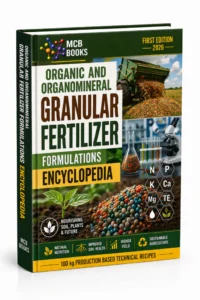
The ORGANIC AND ORGANOMINERAL GRANULAR FERTILIZER FORMULATIONS ENCYCLOPEDIA is designed as a practical technical reference for fertilizer manufacturers, agricultural companies, entrepreneurs, production specialists, and professionals interested in commercial organic and organomineral granular fertilizer production. The book provides valuable information about fertilizer formulations, production principles, raw material functions, manufacturing stages, and quality requirements.
Organic granular fertilizers mainly contain organic nutrient sources and materials that can contribute to soil fertility, biological activity, soil structure, and nutrient availability. Organomineral fertilizers combine organic matter with mineral nutrients such as nitrogen, phosphorus, potassium, calcium, magnesium, sulfur, and essential micronutrients. This combination allows manufacturers to develop fertilizer products designed for different crops, soil conditions, and plant growth stages.
Proper formulation is one of the most important factors in fertilizer manufacturing. Depending on the intended application, organic and organomineral granular fertilizer formulations can be developed for root growth, vegetative development, flowering, fruit formation, crop yield, and overall plant nutrition. Different NPK ratios and micronutrient combinations can also be used to create crop-specific and application-specific fertilizer products.
Raw material selection plays a major role in determining the quality and performance of the final fertilizer. Organic matter sources, humic substances, nitrogen sources, phosphorus compounds, potassium sources, micronutrients, fillers, binders, granulation aids, and coating materials may be used depending on the formulation. Each raw material has a specific function that can influence nutrient content, granule strength, moisture stability, storage properties, and field performance.
Commercial organic and organomineral granular fertilizer manufacturing generally includes raw material preparation, weighing, mixing, moisture adjustment, granulation, drying, cooling, screening, coating, and packaging. These production stages must be carefully controlled to obtain uniform granules and consistent nutrient distribution. Granule size, moisture level, drying conditions, mechanical strength, and storage stability are particularly important for producing high-quality commercial fertilizers.
Quality control is another essential part of fertilizer production. Manufacturers may need to evaluate nutrient concentration, moisture content, particle size distribution, pH, bulk density, granule durability, and storage stability. Consistent quality control helps ensure that every production batch meets the desired technical specifications and commercial standards.
The ORGANIC AND ORGANOMINERAL GRANULAR FERTILIZER FORMULATIONS ENCYCLOPEDIA also focuses on practical production-based formulation concepts. 100 kg production formulas can help manufacturers and formulation specialists understand the quantities and functions of different ingredients more easily. These types of formulations are especially useful when developing NPK-based organomineral fertilizers, humic acid enriched fertilizers, micronutrient-containing products, and specialized fertilizers for different agricultural crops.
Commercial fertilizer production requires more than simply mixing nutrient sources. Successful manufacturing depends on understanding raw material compatibility, formulation balance, granulation technology, production parameters, quality control, and final product specifications. A technically balanced formulation can improve manufacturing efficiency while supporting consistent fertilizer quality and reliable agricultural performance.
For companies planning to enter the fertilizer industry or expand their existing product range, the ORGANIC AND ORGANOMINERAL GRANULAR FERTILIZER FORMULATIONS ENCYCLOPEDIA provides a comprehensive reference for professional fertilizer formulation and production. By combining practical formulations with manufacturing information, the book can support the development of commercial organic and organomineral granular fertilizer products for modern agricultural applications.