HOW TO PRODUCE FRUIT RIPENING REGULATORS:
STEP-BY-STEP INDUSTRIAL FORMULATION GUIDE
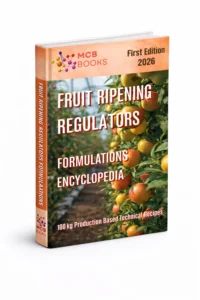 In modern agriculture, controlling the ripening process is essential for maintaining fruit quality, reducing post-harvest losses, and ensuring consistent supply to global markets. This has led to increasing demand for efficient fruit ripening regulator production systems that can deliver predictable and uniform results across different types of fruits. Industrial formulation of ripening regulators combines chemical precision with practical application techniques, making it a key area for agrochemical manufacturers and entrepreneurs.
The fundamental principle behind fruit ripening is driven by ethylene, a natural plant hormone responsible for initiating and accelerating the ripening process. Commercial products are designed either to release ethylene directly or to stimulate its production within the fruit. One of the most widely used active compounds in industrial formulations is Ethephon, which decomposes under controlled pH conditions to release ethylene gas. This controlled release ensures uniform ripening and makes it suitable for large-scale agricultural operations.
The production of fruit ripening regulators begins with the careful selection of raw materials. High-purity Ethephon is typically used as the active ingredient, supported by solvents such as water to create a stable formulation base. In addition, pH regulators like phosphoric acid or citric acid are incorporated to maintain the necessary acidic environment, preventing premature decomposition of the active compound. Surfactants are added to improve the distribution and penetration of the formulation on fruit surfaces, while stabilizers help extend shelf life and maintain product effectiveness during storage.
The industrial formulation process follows a structured step-by-step approach. First, the solvent system is prepared in a mixing tank under controlled temperature and agitation conditions. The active ingredient is then gradually introduced into the solvent, ensuring complete dissolution and homogeneity. Once the base solution is formed, pH adjustment is carried out with precision, as even small deviations can significantly affect product stability. After achieving the desired pH level, auxiliary components such as surfactants and stabilizers are added in sequence to avoid incompatibility issues.
Following formulation, the mixture undergoes filtration to remove impurities and ensure a clear, consistent product. Quality control tests are then performed to verify key parameters such as active ingredient concentration, pH value, and storage stability. These tests are essential to guarantee that the final product performs reliably under different environmental and application conditions. Once approved, the formulation is transferred to packaging units, where it is filled into appropriate containers designed to protect against moisture, light, and temperature fluctuations.
The application of fruit ripening regulators offers significant benefits in commercial agriculture. Producers can synchronize the ripening process across large volumes of fruit, ensuring uniform color development, texture, and taste. This is particularly important for export markets, where consistency and visual appeal directly impact product value. Additionally, controlled ripening allows for better management of transportation and storage, reducing waste and increasing profitability.
However, the success of a ripening regulator depends heavily on formulation quality. Poorly designed products may lead to uneven ripening or reduced fruit quality, which can negatively affect market acceptance. Therefore, manufacturers must focus on optimizing both the chemical composition and the production process to achieve high-performance formulations.
In conclusion, fruit ripening regulator production is a sophisticated industrial process that plays a vital role in modern agriculture. By following a structured formulation approach and using high-quality ingredients, manufacturers can develop effective ripening solutions that meet the demands of commercial farming and global supply chains. As the need for efficient post-harvest management continues to grow, the importance of advanced ripening regulator production systems will only increase.