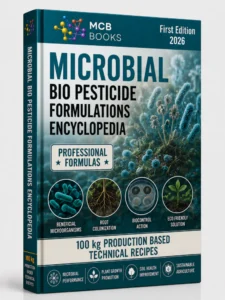
 The increasing demand for sustainable agriculture, reduced chemical pesticide use, and environmentally responsible crop protection has created significant opportunities for microbial biopesticide production. Microbial biopesticides use beneficial microorganisms or their biological activities to help control agricultural pests and plant diseases. The MICROBIAL BIO PESTICIDE FORMULATIONS ENCYCLOPEDIA is designed as a practical technical resource for companies, manufacturers, agricultural professionals, researchers, and entrepreneurs interested in developing commercial microbial biopesticide products.
Microbial biopesticide formulations may contain selected bacteria, fungi, or other beneficial microorganisms developed for specific biological control applications. Common microorganisms used in this field include Bacillus thuringiensis, Trichoderma species, Beauveria bassiana, Metarhizium species, Bacillus subtilis, and other microbial agents used for biological pest and disease management. However, successful commercial production requires much more than selecting an active microorganism. The final product must also provide suitable stability, microbial viability, storage performance, application characteristics, and compatibility with agricultural use.
The MICROBIAL BIO PESTICIDE FORMULATIONS ENCYCLOPEDIA provides practical information about the formulation and manufacturing principles used in microbial biopesticide production. It covers the selection and functions of raw materials such as carriers, dispersing agents, stabilizers, wetting agents, protective materials, suspending agents, fillers, and other formulation components required for producing stable microbial products.
Different microbial biopesticide products can be manufactured in liquid, suspension, wettable powder, dispersible powder, and other suitable agricultural formulation forms depending on the microorganism, intended application method, and target market. Proper formulation is essential because living microbial ingredients can be sensitive to moisture, temperature, pH, oxygen, storage conditions, and interactions with other formulation components.
Another important part of commercial microbial biopesticide manufacturing is the production process itself. Mixing sequence, fermentation or microbial preparation, concentration adjustment, homogenization, drying where required, stabilization, quality control, filling, and packaging must all be carefully managed. The encyclopedia explains these stages from a practical production perspective and helps users understand how laboratory concepts can be transformed into industrial manufacturing procedures.
For companies planning to enter the rapidly developing biological crop protection market, access to practical formulation knowledge can reduce development time and provide a stronger starting point for product design. Instead of relying only on theoretical descriptions, manufacturers need structured formulas, raw material functions, production procedures, technical specifications, and application-oriented information.
The MICROBIAL BIO PESTICIDE FORMULATIONS ENCYCLOPEDIA brings these subjects together in one comprehensive technical reference. It is especially valuable for biopesticide manufacturers, agricultural chemical companies, biological control product developers, formulation specialists, R&D departments, start-up manufacturers, and investors looking for practical information about microbial pesticide technology.
With growing global interest in biological crop protection, microbial biopesticides are becoming an increasingly important part of modern integrated pest management. This encyclopedia provides a practical foundation for understanding microbial biopesticide formulations, production methods, raw materials, manufacturing processes, and commercial product development.