Plant-parasitic nematodes are serious agricultural pests that attack plant roots, weaken root systems, reduce nutrient and water uptake, and can cause significant losses in crop quality and yield. Root-knot nematodes, cyst nematodes, lesion nematodes, and other soil-borne species are especially difficult to ma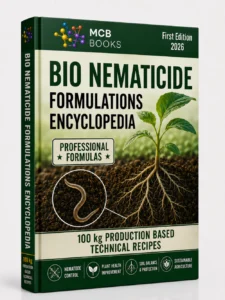 nage because they live primarily in the soil and root zone. For manufacturers developing sustainable crop protection products, 100 kg bio nematicide formulas provide a practical basis for professional and industrial-scale production of biological nematode-control products.
A commercial bio nematicide formulation may contain beneficial microorganisms, microbial metabolites, naturally derived active materials, or other biological components selected according to the target nematode and crop. Microbial agents used in biological nematode management may include selected bacterial and fungal strains capable of interacting with nematodes, their eggs, the rhizosphere, or the surrounding soil environment. The effectiveness of the final product depends not only on the active component but also on the formulation system used to protect and deliver it.
Professional 100 kg bio nematicide formulations may contain carriers, fillers, stabilizers, wetting agents, dispersing agents, suspending agents, protective materials, rheology modifiers, anti-caking agents, and other compatible ingredients. These raw materials help improve product stability, homogeneous distribution, handling, dilution, soil penetration, and application performance. Their selection must be compatible with the biological active material and the intended production method.
Bio nematicides can be developed as liquid concentrates, suspension formulations, powders, granules, soil-treatment products, and formulations suitable for drip irrigation or fertigation. Liquid formulations require careful control of viscosity, sedimentation, pH, and redispersibility, while dry products require attention to moisture content, particle size, flowability, and dispersibility.
Using a standardized 100 kg production formula makes raw material calculation and industrial scaling easier. Each component can be expressed directly in kilograms per 100 kg of finished product, providing manufacturers with a clear production reference. Once a formulation has been tested and validated, larger production batches can be calculated proportionally while maintaining the same formulation ratios.
The manufacturing process may include raw material preparation, controlled mixing, dispersion, homogenization, stabilization, filtration where required, filling, and packaging. When living microorganisms are used, additional stages such as fermentation, cultivation, biomass preparation, spore production, or concentration may also be necessary.
Quality control is essential in commercial production. Parameters may include pH, viscosity, moisture content, particle size, suspension stability, dispersibility, microbial viability, contamination control, biological activity, and storage stability. Packaging must also protect the formulation against excessive heat, moisture, oxygen, and light where necessary.
The BIO NEMATICIDE FORMULATIONS ENCYCLOPEDIA provides practical information on 100 kg formulations, raw material functions, manufacturing procedures, technical properties, and professional agricultural applications. It is designed for bio pesticide manufacturers, agricultural input companies, formulation specialists, R&D departments, entrepreneurs, and investors seeking to develop commercially applicable products for root-knot, soil-borne, and plant-parasitic nematode control.