Heavy-duty cleaning wipes are professional products designed to remove oil, grease, lubricants, adhesives, inks, carbon residues, workshop dirt, and other difficult contaminants from commercial and industrial surfaces. They are widely used in factories, automotive workshops, maintenance departments, warehouses, printing facilities, engineering plants, construction sites, and industrial production areas.
Preparing heavy-duty cleaning wipes solution formulas on a 100 kg basis provides manufacturers with a practical and organized method for calculating raw material quantities. In a properly structured 100 kg production formula, the total amount of all ingredients equals exactly 100 kilograms. This makes it easier to calculate production costs, organize raw material purchasing, compare alternative formulations, conduct pilot trials, and scale the product for larger manufacturing batches.
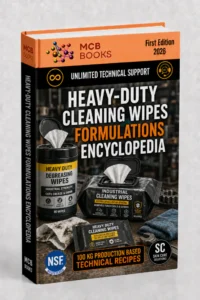
The HEAVY-DUTY CLEANING WIPES FORMULATIONS ENCYCLOPEDIA provides technical formulation concepts for manufacturers, formulation specialists, chemical suppliers, entrepreneurs, private-label producers, and investors seeking professional industrial cleaning wipes formulas. It covers water-based, solvent-based, hybrid, degreasing, machinery-cleaning, adhesive-removal, and multi-surface industrial wipes.
A typical 100 kg heavy-duty cleaning wipes solution may contain purified water, surfactants, cleaning solvents, alkaline builders, chelating agents, corrosion inhibitors, pH regulators, preservatives, solubilizers, hydrotropes, stabilizers, and optional fragrance materials. The exact raw materials and quantities depend on the intended contamination, surface type, cleaning strength, drying rate, residue requirements, and workplace-safety objectives.
Water-based heavy-duty cleaning wipes normally contain purified or deionized water as the main carrier. Low-foam surfactants help loosen oils, grease, and particulate dirt, while water-compatible solvents improve the removal of adhesives, inks, lubricants, and difficult industrial residues. These formulations may provide lower odor and broader surface compatibility than fully solvent-based systems.
Solvent-based formulas may contain alcohols, glycol ethers, esters, hydrocarbons, or other suitable cleaning solvents. They are often developed for heavy grease, adhesive residues, printing inks, waxes, and difficult workshop contamination. Solvent selection should consider evaporation rate, cleaning power, odor, flammability, worker exposure, nonwoven compatibility, and possible effects on painted surfaces, plastics, rubber, and coatings.
The HEAVY-DUTY CLEANING WIPES FORMULATIONS ENCYCLOPEDIA explains how 100 kg formulas can be scaled according to production capacity. For example, a 100 kg formula may theoretically be converted into a 1,000 kg batch by multiplying the quantity of every ingredient by ten. However, industrial scale-up should be confirmed through production trials because mixing time, foam formation, heat transfer, solvent evaporation, and ingredient distribution may change in larger tanks.
During production, purified water is transferred into a clean and chemically compatible mixing vessel. Chelating agents, preservatives, builders, and other water-soluble materials are generally added under controlled agitation. Surfactants, cleaning solvents, corrosion inhibitors, solubilizers, and optional additives are then incorporated in the correct production sequence.
Excessive agitation should be avoided when it causes foam or accelerates solvent evaporation. Volatile or flammable ingredients should be handled with appropriate ventilation, grounding, ignition-source control, safe storage, and personal protective equipment.
Before impregnation, the finished cleaning solution should be tested for appearance, odor, pH, density, viscosity, stability, cleaning performance, residue formation, microbiological quality, and surface compatibility. It should remain homogeneous without unacceptable phase separation, sedimentation, discoloration, or odor changes.
The nonwoven fabric should provide high wet strength, absorbency, abrasion resistance, low lint formation, and controlled solution release. Textured materials may improve mechanical scrubbing, while softer substrates may be selected for more sensitive surfaces.
Accurate liquid loading is essential. Insufficient solution may reduce cleaning performance, while excessive impregnation can cause leakage, increased production costs, and packaging deformation. Finished wipes may be packaged in canisters, industrial buckets, soft packs, refill bags, or individually sealed sachets.
The HEAVY-DUTY CLEANING WIPES FORMULATIONS ENCYCLOPEDIA offers a practical technical foundation for developing 100 kg heavy-duty cleaning wipes solution production formulas. By combining professionally structured formulations, controlled manufacturing methods, compatible nonwoven fabrics, reliable packaging, and consistent quality testing, producers can manufacture effective and commercially competitive industrial cleaning wipes.