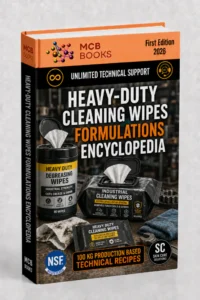
Heavy-duty cleaning wipes are professional products developed to remove oil, grease, lubricants, adhesives, inks, carbon residues, workshop dirt, and other difficult contaminants from commercial and industrial surfaces. Their cleaning performance depends on the correct selection and combination of raw materials. Each ingredient has a specific function related to soil removal, wetting, solvent power, pH control, corrosion protection, preservation, stability, or user experience.
The HEAVY-DUTY CLEANING WIPES FORMULATIONS ENCYCLOPEDIA provides practical technical information about the raw materials used in professional industrial cleaning wipes. It supports manufacturers, formulation specialists, chemical suppliers, private-label producers, entrepreneurs, and investors seeking to understand how different ingredients work together in water-based, solvent-based, and hybrid cleaning systems.
Purified or deionized water is commonly used as the main carrier in water-based heavy-duty cleaning wipes. Water quality is important because minerals and impurities can reduce cleaning efficiency, cause instability, or react with other ingredients. A controlled water-treatment system can improve product consistency, solution clarity, and shelf-life performance.
Surfactants are among the most important raw materials in industrial cleaning formulations. They reduce surface tension, improve wetting, and help separate oils, grease, and particulate dirt from the treated surface. Low-foam nonionic surfactants are frequently selected because they can provide effective degreasing without producing excessive foam or sticky residues. Anionic and amphoteric surfactants may also be used when compatible with the complete formulation.
Cleaning solvents improve the removal of heavy oils, lubricants, inks, adhesives, waxes, sealants, and other difficult soils. Alcohols, glycol ethers, esters, hydrocarbons, and other suitable solvents may be selected according to cleaning strength, evaporation rate, odor, residue level, flammability, and surface compatibility. A solvent that performs well on metal machinery may not be suitable for plastics, rubber, painted surfaces, or sensitive coatings.
Alkaline builders can strengthen the removal of grease, carbonized residues, and industrial dirt. They support surfactant performance and may help break down difficult contamination. However, excessive alkalinity can damage aluminum, painted surfaces, plastics, rubber, and protective coatings. The builder level and final pH must therefore be carefully controlled.
Chelating agents bind calcium, magnesium, iron, and other metal ions that may interfere with surfactant performance. They can improve cleaning efficiency in hard-water conditions, reduce deposits, and support formulation stability. Their effectiveness depends on the final pH and compatibility with the other raw materials.
The HEAVY-DUTY CLEANING WIPES FORMULATIONS ENCYCLOPEDIA explains how corrosion inhibitors can be incorporated into formulas intended for metal tools, machinery, workshop equipment, and industrial surfaces. These ingredients help reduce the risk of corrosion caused by water, alkaline materials, solvents, or repeated product use. Nevertheless, finished wipes should always be tested on the intended metals.
pH regulators and buffer systems are used to achieve and maintain the required acidity or alkalinity. The correct pH can improve cleaning performance, formulation stability, preservative efficiency, and material compatibility. The pH should be measured during every production batch and monitored throughout stability testing.
Preservatives are necessary in water-based wipes because high-water formulations can become vulnerable to bacteria, yeast, and mold. The selected preservative system must be compatible with the surfactants, solvents, pH, nonwoven fabric, and packaging. Microbiological testing and preservative-performance evaluation are essential before commercial production.
Solubilizers and hydrotropes may be used to help distribute fragrances, solvents, and other poorly water-soluble ingredients throughout the formulation. Stabilizers can reduce separation, sedimentation, discoloration, and unacceptable odor changes during storage. Fragrances and colorants are optional and should not interfere with cleaning performance or leave undesirable residues.
The nonwoven substrate is also a major raw material. Industrial wipes should provide high wet strength, abrasion resistance, absorbency, low lint formation, and controlled liquid release. Textured fabrics can improve mechanical scrubbing, while softer materials may be preferred for delicate surfaces.
The HEAVY-DUTY CLEANING WIPES FORMULATIONS ENCYCLOPEDIA offers a valuable foundation for selecting raw materials for degreasing wipes, machinery wipes, workshop wipes, adhesive-removal wipes, ink-removal wipes, and multi-surface industrial products. By balancing cleaning strength, safety, stability, fabric compatibility, and packaging performance, manufacturers can develop reliable and commercially competitive heavy-duty cleaning wipes.