 Quality control is one of the most important stages in granular NPK fertilizer manufacturing. A commercially successful fertilizer must contain the declared nitrogen, phosphorus, and potassium levels while also meeting physical requirements such as uniform particle size, suitable moisture content, adequate granule hardness, low dust formation, good flowability, and resistance to caking. Consistent testing throughout production helps manufacturers reduce batch variations, prevent customer complaints, and supply reliable fertilizer products to agricultural markets.
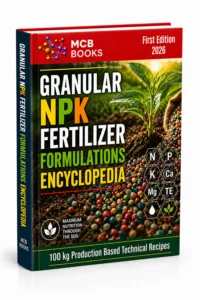
Quality control begins with the inspection of incoming raw materials. Urea, ammonium sulfate, monoammonium phosphate, diammonium phosphate, potassium chloride, potassium sulfate, fillers, binders, micronutrients, and coating agents should be checked for nutrient concentration, purity, moisture, particle size, contamination, and storage condition. Differences in raw material quality may change the final nutrient analysis or affect granulation performance. The GRANULAR NPK FERTILIZER FORMULATIONS ENCYCLOPEDIA provides useful technical guidance for selecting suitable ingredients and developing stable commercial fertilizer formulations.
During production, weighing accuracy and mixing uniformity must be controlled carefully. Incorrect dosing can cause the finished fertilizer to fall outside its declared NPK specification. Samples should be taken from different points of the mixture to confirm that nutrients are distributed evenly. Granulation conditions such as moisture addition, binder dosage, temperature, equipment speed, and residence time should also be monitored because they directly affect granule size and mechanical strength.
Moisture content is an essential technical parameter in granular fertilizer production. Excessive moisture may increase caking, reduce storage stability, and create packaging problems. Very low moisture combined with unsuitable processing conditions may increase dust and granule breakage. Drying and cooling systems must therefore operate under controlled conditions to obtain a stable product before screening and packaging.
Particle-size distribution is another important quality specification. Commercial granular NPK fertilizers should contain a high proportion of granules within the selected size range. Oversized particles may reduce spreading uniformity, while excessive fines create dust and product losses. Screening efficiency, granule hardness, bulk density, flowability, and crushing resistance should be evaluated regularly.
Chemical analysis confirms the total nitrogen, available phosphorus, and water-soluble potassium content of the fertilizer. Depending on the formulation, sulfur, magnesium, calcium, zinc, iron, manganese, boron, copper, or other nutrients may also be tested. The GRANULAR NPK FERTILIZER FORMULATIONS ENCYCLOPEDIA helps manufacturers understand how formulation design, raw material selection, and processing conditions influence both chemical and physical product quality.
Finished fertilizer should also be examined for color, odor, dust level, caking tendency, coating uniformity, packaging weight, label accuracy, and storage stability. Representative samples from each batch should be retained for future reference and traceability. Production records should include raw material lot numbers, batch quantities, process conditions, laboratory results, packaging details, and corrective actions.
The GRANULAR NPK FERTILIZER FORMULATIONS ENCYCLOPEDIA is a valuable technical resource for fertilizer manufacturers, production managers, agricultural engineers, laboratory personnel, researchers, and entrepreneurs. Effective quality-control procedures and clearly defined technical specifications help producers manufacture consistent, stable, and marketable granular NPK fertilizers suitable for professional agricultural use.