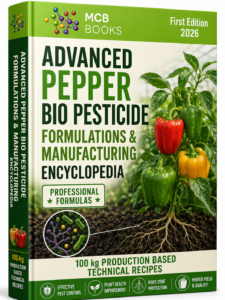
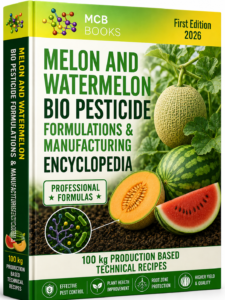
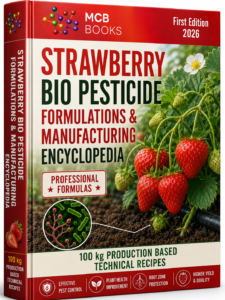
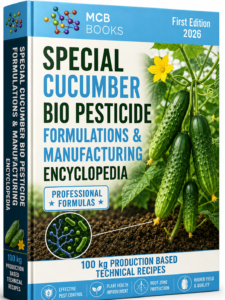
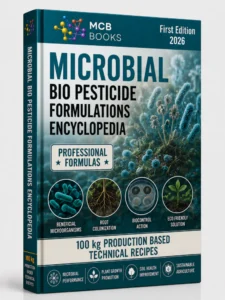
 The commercial production of microbial biopesticides requires carefully designed formulations that combine effective biological agents with suitable carriers, stabilizers, dispersing agents, protective materials, and other formulation components. For manufacturers planning professional or industrial-scale production, 100 kg microbial biopesticide formulas provide a practical reference point for developing standardized batches and organizing production processes. The MICROBIAL BIO PESTICIDE FORMULATIONS ENCYCLOPEDIA offers technical guidance for companies interested in manufacturing microbial crop protection products for modern agriculture.
Microbial biopesticides are based on beneficial microorganisms that can help control insects, plant pathogens, and other agricultural pests. Frequently used biological agents include Bacillus thuringiensis, Bacillus subtilis, Trichoderma species, Beauveria bassiana, and Metarhizium species. Each microorganism has different requirements in terms of moisture, pH, storage conditions, carrier compatibility, stability, and formulation type. Therefore, microbial biopesticide formulas must be developed according to the biological characteristics of the selected active microorganism.
A professional 100 kg microbial biopesticide formulation normally consists of more than the microbial active ingredient alone. Depending on the intended product type, manufacturers may use carriers, fillers, dispersing agents, wetting agents, suspending agents, stabilizers, protective agents, anti-caking materials, and other supporting ingredients. These components are selected to help protect microbial viability while improving product handling, dispersion, storage stability, and field application performance.
Different formulation technologies can be used for industrial microbial pesticide production. Liquid microbial biopesticides may be designed as concentrated or suspension-based products suitable for dilution before agricultural application. Powder formulations may include wettable powders, dispersible powders, or carrier-based microbial preparations. Granular products may also be developed for specific soil or crop applications. The final formulation type depends on the microorganism, target pest, application equipment, storage requirements, and commercial market conditions.
Scaling a formulation to 100 kg production is especially useful for manufacturers because it creates a standardized basis for raw material calculation and production planning. Raw materials can be expressed directly as kilograms per 100 kg batch, making it easier to calculate larger industrial quantities. Once a formulation has been validated at pilot scale, production quantities can be adjusted proportionally for larger manufacturing batches while maintaining the same formulation ratios and quality specifications.
The manufacturing process is another critical part of microbial biopesticide production. Depending on the product, production may include preparation of the carrier phase, controlled incorporation of the microbial component, mixing, dispersion, homogenization, stabilization, moisture control, drying where applicable, sieving, filling, and packaging. Excessive temperature, inappropriate pH, unsuitable mixing conditions, or incompatible raw materials may reduce microbial viability, so process conditions must be carefully controlled.
Quality control is essential in every production batch. Important parameters may include microbial viability, microbial concentration, purity, contamination control, pH, moisture content, suspension properties, dispersibility, physical stability, and storage stability. Establishing consistent specifications helps manufacturers maintain uniform product quality during commercial production.
Packaging and storage should also be selected according to the sensitivity of the microbial formulation. Protection against excessive heat, humidity, oxygen, and light may be necessary to maintain acceptable shelf life and biological performance.
The MICROBIAL BIO PESTICIDE FORMULATIONS ENCYCLOPEDIA is developed for biopesticide manufacturers, agricultural input companies, formulation specialists, R&D teams, entrepreneurs, and investors seeking practical information about microbial pesticide manufacturing. By providing structured information on 100 kg microbial biopesticide formulas, raw material functions, production methods, technical specifications, and formulation principles, the encyclopedia can serve as a valuable technical reference for professional and industrial microbial biopesticide development.
For companies entering the biological crop protection industry, standardized formulation knowledge can help shorten product development processes and provide a stronger foundation for creating reliable, commercially applicable microbial biopesticide products.