Granular NPK fertilizers are essential tools in modern agriculture, providing plants with the three primary nutrients required for healthy growth: nitrogen (N), phosphorus (P), and potassium (K). Understanding how these fertilizers are formulated—both in terms of ingredients and ratios—is critical for manufacturers, agronomists, and agricultural entrepreneurs who want to produce effective and marketable products.
At the core of every NPK fertilizer formula are carefully selected raw materials that supply each nutrient. Nitrogen is typically derived from sources such as urea, ammonium sulfate, or ammonium nitrate. Urea is widely preferred due to its high nitrogen content and cost efficiency, while ammonium sulfate is valued for providing additional sulfur, which benefits certain crops. The choice of nitrogen source can influence not only nutrient release but also soil pH and product stability.
Phosphorus is introduced through materials like monoammonium phosphate (MAP), diammonium phosphate (DAP), or phosphoric acid-based systems. MAP is commonly used in balanced formulations because of its compatibility with other ingredients and relatively neutral pH. DAP, on the other hand, offers higher phosphorus concentration, making it suitable for formulations designed to support strong root development and early plant growth.
Potassium is usually supplied by potassium chloride (MOP) or potassium sulfate (SOP). MOP is the most widely used due to its affordability and high potassium content, but SOP is preferred for chloride-sensitive crops such as fruits and vegetables. The selection of potassium source plays a significant role in determining both the agronomic suitability and market positioning of the fertilizer.
The ratios of NPK in a fertilizer formula are expressed as numbers such as 15-15-15, 20-10-10, or 12-12-17. These numbers represent the percentage of nitrogen, phosphorus (as P₂O₅), and potassium (as K₂O) in the product. Balanced formulations like 15-15-15 are suitable for general-purpose use, while specialized ratios are designed to meet specific crop needs. For example, higher nitrogen ratios support vegetative growth, phosphorus-rich formulations promote root development, and potassium-dominant formulas enhance fruit quality and stress resistance.
Beyond primary nutrients, modern granular NPK fertilizers often include secondary nutrients such as calcium, magnesium, and sulfur, along with micronutrients like zinc, boron, iron, and manganese. These additions improve overall nutrient efficiency and address specific deficiencies in soil, making the fertilizer more effective and valuable for farmers.
The production process of granular NPK fertilizers begins with accurate weighing and mixing of raw materials to achieve the desired ratio. Homogeneous mixing is crucial to ensure that each granule contains a consistent nutrient composition. The mixture is then subjected to granulation, where fine particles are transformed into granules using equipment such as drum granulators or pan granulators. Moisture, steam, or binding agents are added during this stage to promote particle adhesion.
Following granulation, the material is dried to reduce moisture content and improve storage stability. The dried granules are then screened to achieve a uniform size, typically between 2–5 mm. Oversized and undersized particles are recycled back into the process, ensuring efficient use of raw materials. Cooling is applied to strengthen the granules and prevent condensation, and finally, coating agents may be added to enhance flowability and prevent caking.
Quality control is a vital part of the entire process. Manufacturers must verify nutrient content, particle size distribution, moisture levels, and granule hardness to ensure product consistency and compliance with industry standards. A well-formulated and properly manufactured granular NPK fertilizer delivers reliable results in the field, supporting crop growth and maximizing yield.
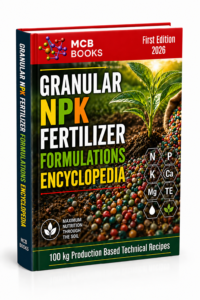
For professionals seeking detailed industrial formulations, exact raw material quantities, and 100 kg production-based recipes, the Granular NPK Fertilizer Formulations Encyclopedia provides a comprehensive and practical reference. It is an invaluable resource for anyone aiming to produce high-performance granular fertilizers for commercial agriculture.