Producing high-quality granular NPK fertilizer is essential for meeting the demands of modern agriculture, where farmers expect consistent performance, efficient nutrient delivery, and easy application. For manufacturers, success depends on combining the right raw materials, optimized formulation strategies, and controlled production processes to achieve strong, uniform granules with reliable agronomic results.
The first step in producing high-quality granular NPK fertilizer is selecting appropriate raw materials. Nitrogen is typically supplied through urea, ammonium sulfate, or ammonium nitrate, each offering different release characteristics and cost structures. Phosphorus is commonly sourced from monoammonium phosphate (MAP), diammonium phosphate (DAP), or phosphoric acid systems, while potassium is provided by potassium chloride (MOP) or potassium sulfate (SOP). The choice of these materials must align with the target crop requirements and market positioning of the product.
Formulation design plays a critical role in determining fertilizer quality. Common NPK ratios such as 15-15-15, 20-10-10, or 12-12-17 are developed based on crop nutrition needs. However, beyond simply balancing nutrients, manufacturers must ensure chemical compatibility between raw materials. Poor formulation can lead to nutrient segregation, low solubility, or unstable granules. Advanced formulations may also include secondary nutrients like sulfur and magnesium, as well as micronutrients such as zinc, boron, and iron to enhance crop performance.
Once the formulation is finalized, the production process begins with precise weighing and mixing of raw materials. Homogeneous mixing ensures that each granule contains a balanced nutrient composition. This step is essential for maintaining product consistency and delivering uniform results in the field.
Granulation is the core stage of the manufacturing process. In industrial production, drum granulators or pan granulators are commonly used. During granulation, the powdered mixture is transformed into granules through the addition of moisture, steam, or binding agents. Process parameters such as moisture level, temperature, and retention time must be carefully controlled. Proper granulation results in strong, well-formed particles with minimal dust generation.
After granulation, the material is transferred to a drying system. Drying reduces moisture content to a stable level, typically below 2–3%, which prevents caking and improves shelf life. Rotary dryers are widely used in fertilizer plants to achieve uniform moisture reduction without damaging nutrient integrity.
The next step is screening, where granules are classified based on size. High-quality granular fertilizers usually have a particle size range of 2–5 mm, suitable for mechanical spreading. Oversized particles are crushed and recycled, while undersized particles are returned to the granulator. This closed-loop system enhances production efficiency and ensures uniformity.
Cooling is another important stage in producing durable granules. Hot granules are cooled using air systems to increase hardness and prevent condensation during storage. Once cooled, the product may undergo a coating process. Anti-caking agents and surface conditioners are applied to improve flowability, reduce dust, and extend storage stability.
Quality control is essential throughout the entire process. Manufacturers must regularly test nutrient content, moisture levels, granule hardness, particle size distribution, and storage behavior. Consistent quality not only ensures compliance with industry standards but also builds trust with customers in the agricultural market.
In addition to technical quality, cost efficiency is a key factor for commercial success. Manufacturers must optimize raw material selection, energy consumption, and process efficiency to produce competitive products without compromising performance.
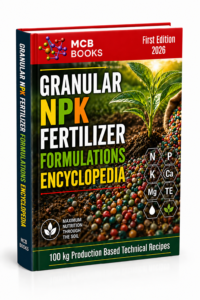
For those who want to go beyond general production knowledge and access real industrial formulations, the Granular NPK Fertilizer Formulations Encyclopedia offers detailed 100 kg production-based recipes, raw material specifications, and step-by-step manufacturing guidance. It is an essential resource for fertilizer manufacturers, entrepreneurs, and product developers aiming to produce high-quality granular NPK fertilizers for the farming industry.