Granular NPK fertilizers are the backbone of modern commercial agriculture, offering balanced nutrition, easy application, and long-term storage stability. For manufacturers and agribusiness professionals, selecting the right formulation is not just about combining nitrogen (N), phosphorus (P), and potassium (K); it is about designing products that match crop demand, soil conditions, and market expectations. The most successful granular NPK formulations are those that deliver consistent performance, strong granule quality, and high nutrient efficiency.
One of the most widely used formulations in commercial agriculture is the balanced 15-15-15 NPK. This formulation provides equal proportions of nitrogen, phosphorus, and potassium, making it suitable for general-purpose use across a wide range of crops. It supports vegetative growth, root development, and overall plant health. Due to its versatility, 15-15-15 is commonly preferred by farmers who need a reliable, all-in-one fertilizer solution.
For crops requiring stronger vegetative growth, high-nitrogen formulations such as 20-10-10 are often recommended. These formulations promote rapid leaf development and chlorophyll production, making them ideal for early growth stages and leafy crops. Nitrogen sources like urea or ammonium sulfate are typically used in these systems, depending on cost and desired release characteristics.
In contrast, phosphorus-rich formulations such as 10-20-10 or 12-24-12 are designed to enhance root development and support early-stage crop establishment. These formulations are particularly valuable in transplanting conditions and in soils with low phosphorus availability. Phosphorus sources such as monoammonium phosphate (MAP) or diammonium phosphate (DAP) are commonly used due to their high solubility and efficiency.
For fruiting and flowering crops, potassium-dominant formulations like 12-12-17 or 10-10-20 provide significant advantages. Potassium plays a key role in water regulation, enzyme activation, and fruit quality improvement. Crops such as tomatoes, peppers, citrus, and grapes benefit from higher potassium levels, especially during the flowering and fruit development stages.
In addition to primary nutrients, modern granular NPK fertilizers often include secondary nutrients and micronutrients. Elements such as magnesium, calcium, sulfur, zinc, boron, and iron can be incorporated into the formulation to address specific soil deficiencies and improve crop yield. These value-added formulations are increasingly popular in commercial agriculture because they offer targeted nutrition and higher return on investment for farmers.
Another critical factor in formulation design is granule quality. High-quality granules should have uniform size (typically 2–5 mm), good hardness, low dust content, and resistance to caking. Achieving these properties requires proper selection of raw materials, binders, and granulation techniques. Manufacturing methods such as drum granulation or compaction granulation play a key role in determining the final product quality.
Cost optimization is also essential for commercial success. Manufacturers must balance raw material costs with product performance. For example, using potassium chloride (MOP) instead of potassium sulfate (SOP) can reduce costs, but may not be suitable for chloride-sensitive crops. Therefore, formulation decisions should always consider both agronomic effectiveness and market positioning.
In today’s competitive fertilizer market, companies that offer optimized, crop-specific, and high-quality granular NPK formulations gain a significant advantage. Whether targeting large-scale farming operations or export markets, the ability to develop reliable and efficient fertilizer products is a key driver of long-term success.
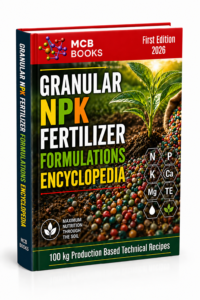
For professionals who want access to real industrial formulations, detailed raw material compositions, and 100 kg production-based recipes, the Granular NPK Fertilizer Formulations Encyclopedia provides a comprehensive resource. It is specifically designed for manufacturers, entrepreneurs, and agricultural professionals looking to produce high-performance granular fertilizers for commercial agriculture.