 Granular NPK fertilizers are essential plant nutrition products used in field crops, fruit production, vegetable cultivation, greenhouse farming, and many other agricultural applications. They supply nitrogen, phosphorus, and potassium in carefully calculated ratios to support vegetative growth, root development, flowering, fruit formation, crop yield, and product quality. For commercial fertilizer manufacturers, developing accurate 100 kg granular NPK fertilizer formulas provides a practical foundation for laboratory trials, pilot production, cost calculations, and industrial-scale manufacturing.
A 100 kg fertilizer formulation allows manufacturers to calculate each raw material as a direct percentage of the final product. For example, one kilogram of a raw material represents one percent of the total formulation. This approach simplifies nutrient calculations and makes it easier to scale production from 100 kg to 1,000 kg or larger batches. However, every formulation must be adjusted according to the nutrient content and purity of the selected raw materials.
Common raw materials used in granular NPK fertilizer production include urea, ammonium sulfate, monoammonium phosphate, diammonium phosphate, potassium chloride, potassium sulfate, limestone, dolomite, fillers, binders, anticaking agents, coating materials, and micronutrient compounds. The correct combination of these ingredients depends on the desired fertilizer grade, production method, crop requirements, soil conditions, and regional agricultural practices.
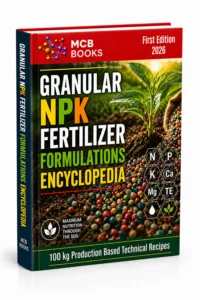
Popular commercial products include NPK 15-15-15, NPK 20-10-10, NPK 12-12-17, NPK 10-20-20, and NPK 8-24-24 fertilizers. Manufacturers may also develop customized formulas enriched with magnesium, sulfur, zinc, iron, manganese, boron, or other secondary and micronutrients. The GRANULAR NPK FERTILIZER FORMULATIONS ENCYCLOPEDIA provides structured technical guidance for understanding different nutrient ratios, raw material functions, and commercial production requirements.
The manufacturing process generally begins with raw material inspection, crushing, screening, weighing, and mixing. The homogeneous powder mixture is then transferred to a granulation system. Water, steam, or a suitable binder may be introduced to promote granule formation. Wet granules are dried, cooled, and screened to obtain the required particle-size range. Oversized granules can be crushed, while undersized material may be recycled into the production process.
After screening, the fertilizer may be treated with coating or anticaking agents to improve flowability, reduce dust, prevent caking, and increase storage stability. Finished products should be tested for nitrogen, phosphorus, and potassium content, moisture, particle size, bulk density, granule hardness, pH, nutrient uniformity, and packaging stability.
The GRANULAR NPK FERTILIZER FORMULATIONS ENCYCLOPEDIA can support fertilizer manufacturers, agricultural engineers, production managers, investors, researchers, and entrepreneurs seeking practical information about commercial fertilizer manufacturing. Accurate 100 kg formulas help reduce calculation errors, improve production consistency, control raw material costs, and simplify batch scaling.
With practical production formulas, manufacturing instructions, technical specifications, and raw material information, the GRANULAR NPK FERTILIZER FORMULATIONS ENCYCLOPEDIA is a valuable reference for businesses planning to develop high-quality, stable, and marketable granular NPK fertilizer products.