Granular NPK fertilizer production requires carefully controlled manufacturing stages to obtain uniform, durable, free-flowing, and commercially acceptable fertilizer granules. Nitrogen, phosphorus, and potassium sources must be combined according to the target nutrient grade, while the physical production process must be managed to achieve suitable particle size, moisture content, hardness, and storage stability. Granulation, drying, screening, and coating are among the most important stages affecting the final quality of granular compound fertilizers.
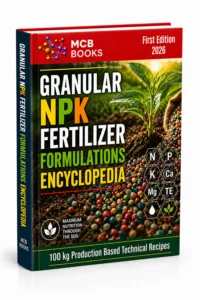
Production begins with the preparation and accurate weighing of raw materials. Common ingredients may include urea, ammonium sulfate, monoammonium phosphate, diammonium phosphate, potassium chloride, potassium sulfate, fillers, binders, micronutrients, and process conditioners. The selected materials are crushed or screened when necessary and then mixed thoroughly to ensure uniform nutrient distribution. The GRANULAR NPK FERTILIZER FORMULATIONS ENCYCLOPEDIA provides practical information about raw material selection, nutrient ratios, and production procedures for different commercial fertilizer grades.
Granulation transforms the prepared powder mixture into solid fertilizer particles. The blended raw materials are transferred into a drum granulator, pan granulator, or another suitable granulation system. Water, steam, or a liquid binder may be sprayed onto the mixture to promote particle adhesion and granule growth. Moisture level, feed rate, residence time, equipment speed, and temperature must be controlled carefully. Excessive moisture can produce soft or oversized granules, while insufficient moisture may lead to weak particles and excessive dust.
After granulation, the wet fertilizer is transferred to the drying stage. Drying removes excess moisture, increases granule strength, and improves storage performance. Rotary dryers are commonly used in commercial fertilizer plants because they can process large quantities continuously. The drying temperature and residence time should be controlled to avoid nutrient degradation, excessive dust formation, or damage to the granules. The dried fertilizer is normally cooled before screening to reduce condensation and prevent caking inside storage or packaging systems.
Screening separates the product according to particle size. Granules within the required size range are directed toward final processing, while oversized particles are crushed and returned to production. Undersized particles and fines may also be recycled into the granulator. Efficient screening improves product uniformity, spreading performance, packaging appearance, and customer acceptance.
The final stage may include coating the granules with anticaking, dust-control, or protective agents. Coating improves flowability, reduces moisture absorption, limits dust formation, and helps prevent granules from sticking together during storage and transportation. The GRANULAR NPK FERTILIZER FORMULATIONS ENCYCLOPEDIA explains how these production stages contribute to consistent and marketable fertilizer quality.
Finished granular NPK fertilizers should be tested for nutrient content, moisture, granule hardness, particle-size distribution, bulk density, dust level, and caking tendency. By controlling granulation, drying, screening, and coating correctly, manufacturers can reduce production losses and obtain stable fertilizer products. The GRANULAR NPK FERTILIZER FORMULATIONS ENCYCLOPEDIA is a valuable technical resource for fertilizer manufacturers, agricultural engineers, production managers, investors, and entrepreneurs seeking to develop professional granular NPK fertilizers for commercial agricultural markets.